Groundhog Day
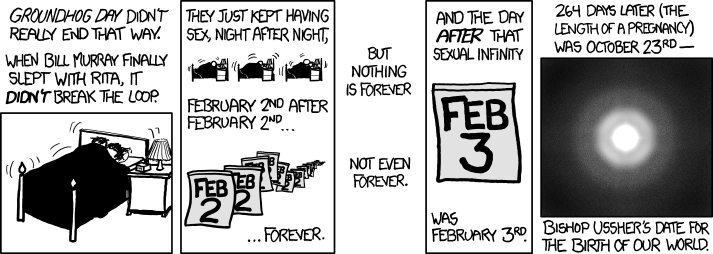
If you closely examine the cosmic background radiation, you can pick up lingering echoes of 'I Got You Babe'.
If you closely examine the cosmic background radiation, you can pick up lingering echoes of 'I Got You Babe'.
Groundhog Day is a philosophical comedy film from 1993. The main character Phil, portrayed by Bill Murray, finds himself in a time loop, which forces him to relive the same day (February 2) over and over again. This date is the titular Groundhog Day, which is celebrated in Punxsutawney, Pennsylvania, where the film is set. The folklore ritual consists in removing a groundhog from its burrow. If the sun is shining and the groundhog can see its own shadow, the winter is assumed to continue for six more weeks.
During the course of the film, Phil makes more and more drastic attempts to end the time loop, but not even suicide can prevent his waking up every morning on February 2 with the clock radio on his nightstand invariably playing I Got You Babe by Sonny & Cher. Eventually, his character improves and he finds himself increasingly attached to his coworker Rita (portrayed by Andie MacDowell). The pair gets closer, and, in the end, they sleep together. This breaks the time loop, and Murray's character can finally wake up on February 3. However, whether they had sex before this final scene is disputed, as Phil is still wearing the same clothes as the night before and, when Phil starts kissing her in the morning, Rita comments that he wasn’t so affectionate the previous night. It is therefore left in doubt if they did anything more than literally sleep in the same bed. Randall was apparently not aware of this and apologized for it.
The comic assumes that the loop was indeed not broken, and that Phil and Rita simply had sex night after night for all eternity. It is then stated that not even forever is forever. This can be explained with the mathematical set theory developed by Georg Cantor. Cantor distinguished between transfinite numbers, which are larger than all finite numbers, yet not infinite, and the concept of Absolute Infinity, which he equaled with God. It was a common concern in Cantor's time to preserve the consistency between mathematics and Christian belief. Cantor's philosophical conception of infinity would allow the comic's scenario to eventually reach the transfinite date of February 3.
The last panel references the chronology of the history of the world of Archbishop James Ussher. Ussher deduced the age of the world from the timeline of the Old Testament and calculated the date of Creation to have been nightfall preceding 23 October, 4004 BC. The comic observes that October 23 is exactly 264 days after February 3, which corresponds to the average length of pregnancy. This calculation draws on Ussher's own methodology, which was basically to add the lifespans of the Old Testament genealogy. Although the universe is much older than 6000 years, chronologies like Ussher's can sometimes be found in the arguments of Young Earth Creationism. The comic might therefore be seen as a sideswipe to these theories by introducing Groundhog Day as a possible creation myth. The creation myths of many cultures claim that Earth was born by some sort primordial mother. Here, this role would be assumed by Rita.
The title text refers to the cosmic microwave background radiation, which is often called the lingering sound of the Big Bang and regarded as a strong proof for it. If the universe were indeed the offspring of the film's protagonists, we might hear the faint echo of Murray's clock radio lingering in the cosmic background.