Knights
1. Nf3 ... ↘↘↘ 2. Nc3 ... ↘↘↘ 0-1
1. Nf3 ... ↘↘↘ 2. Nc3 ... ↘↘↘ 0-1
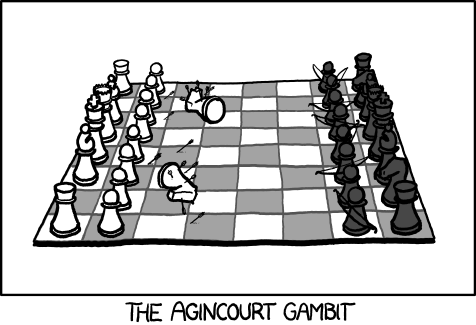
This comic is comparing the opening moves of the game of chess to the opening moves of the Battle of Agincourt, which was fought between the English and the French in the Hundred Years War. In the battle, just like in the comic, the English used their longbowmen effectively, neutralizing the French knights and infantry. The two pieces that are moved out of the white side of the board are both the pieces known as the knights. White moves first in chess, and in the actual battle, the French knights on horseback attacked first; the English being the black pieces may also be a reference to Edward the Black Prince, who was a prominent figure in an earlier stage of the Hundred Years War. As you can see, the pawns (foot soldiers) on the right side of the chess board have bows.
The word "gambit" means "an opening in chess, in which a minor piece or a pawn is sacrificed to gain an advantage". The usual gambit of sacrificing a pawn is subverted to be a sacrifice of a high-value piece, as an analogy of what happened at Agincourt.
The title text uses algebraic chess notation. Nf3 means a knight has moved to square f3. N means knight because the king piece uses the K abbreviation. What comes after the typical chess move is what can only be read as a hail of arrows. 0-1 at the end means that "Black Wins". This implies that White resigned, as he is not in checkmate (for non-timed chess games, the only ways to win are by checkmating your opponent or by having them resign). It seems to be an error that ellipses are included before Black's moves, as algebraic notation uses ellipses only to indicate that White's move has been omitted.