The Food Size Cycle
There's data suggesting that this model may apply to deep-dish/thin-crust pizza. I've designed a thorough multi-year study to investigate this personally, but funding organizations keep denying my grant requests.
There's data suggesting that this model may apply to deep-dish/thin-crust pizza. I've designed a thorough multi-year study to investigate this personally, but funding organizations keep denying my grant requests.
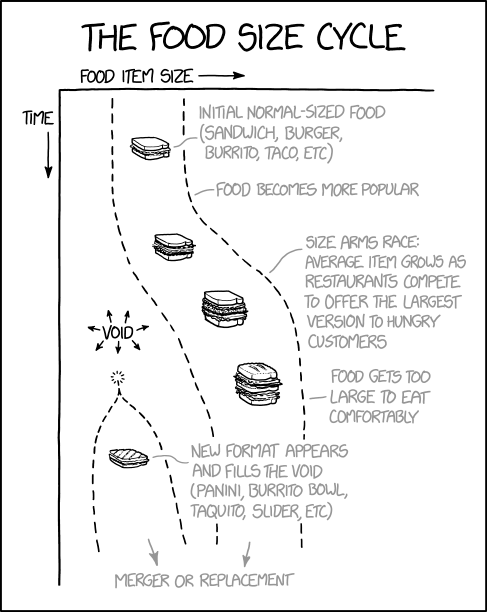
This comic illustrates the evolution of the size of food items over time, using the example of a sandwich. It starts with a regular sandwich at the beginning. As the sandwich became more popular, sandwich makers had an arms race concerning sandwich size as they competed for customers. Eventually, these sandwiches became too big to eat comfortably. At this point (according to Randall) some smart guy invented the panini, a small sandwich, to cater to those who couldn't find a sandwich small enough for their needs. Eventually, the panini itself will begin to grow, and either displace or become indistinguishable from the existing giant sandwiches, and the cycle will repeat. This is similar to Clayton Christensen's theory of disruption, where products keep adding features beyond what is needed by customers, and is then resolved by cheaper products with adequate features.
The title text suggests that the same cycle may be applicable to the depth of pizza crust, with thin crusts being replaced with deeper and deeper ones, eventually necessitating a resurgence in thin crust. Randall laments that despite seeking funding to conduct experiments to test that hypothesis, he keeps getting turned down, probably because it sounds suspiciously like he wants to be paid for eating pizza.