Dying Gift
And to you, I leave my life-sized ice sculpture replica of the Pietà which was blessed by the Pope. You must never let it melt! Now, remember, all gifts must be removed from my estate within 24 hours.
And to you, I leave my life-sized ice sculpture replica of the Pietà which was blessed by the Pope. You must never let it melt! Now, remember, all gifts must be removed from my estate within 24 hours.
In some cultures it is customary to make bequests, usually in written form called a will, of some or all of your possessions, to be given to people close to you after your death. Often, items bequeathed may be of purely sentimental value to the giver. That sentimental value may not carry over to the recipient, but they may, nonetheless, feel obliged to keep possession of them in order to respect the giver's wishes. In some cases, if the items are unwanted, unusable, or the recipient simply doesn't know what to do with them, they may elect to place the items in storage, rather than dispose of them.
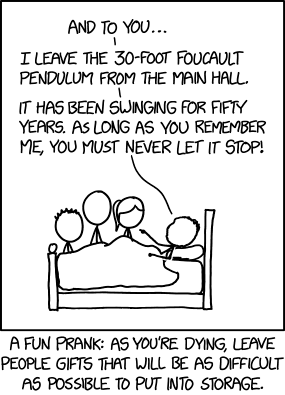
Randall therefore suggests the following prank to be played by someone near death: bequeath an item that is intentionally very difficult to store or even move. In this case, the old dying man gives his Foucault pendulum to someone in his family.
A Foucault pendulum is a type of pendulum that is commonly used in science museums to practically demonstrate the rotation of the Earth. In order to attain the sensitivity required to do this, the pendulum must be very long - in this case, it is thirty feet (approximately nine meters) in length: about the height of a large hall. It must also be undisturbed; any disruption, such as a touch on the pendulum, will prevent it from accurately portraying the rotation of the Earth.
By insisting that the pendulum never stop swinging, the old man has made it impossible for the pendulum to be simply detached and stowed away. Even transporting it will be extremely difficult, as it is thirty feet tall, and any change to its orientation will disrupt its swing. (Note, however, that the old man didn't specify that it has to work as a Foucault pendulum; merely, that it must not stop swinging.) He has also added an extra layer of guilt to the 'gift' by suggesting that if they do ever let it stop swinging it will be because they have forgotten him.
The title text takes it even further, with a life-sized ice sculpture replica of the Pietà which was blessed by the Pope. A Pietà is a representation of the body of Jesus Christ on the lap of his mother, Mary, in the aftermath of his Crucifixion. When styled "The Pietà" it usually refers to Pietà a Renaissance sculpture by Florentine artist Michelangelo. It is widely considered one of the masterpieces of sculpture. While replicas of Pietà do exist, there are none known to have been made of ice, let alone made of ice and blessed by the Pope. That said, if such a sculpture were made, there are several ways to obtain a papal blessing. Such a sculpture would be over six feet tall and weigh several tons, and would have to be constantly maintained at sub-zero temperatures. While the gift could potentially be very valuable, the statement "all gifts must be removed from my estate within 24 hours" would dramatically increase its chances of melting.
For both the pendulum and the ice sculpture, it is theoretically possible to devise a way to remove, transport, and store them with all the necessary conditions met, but they would probably be huge and very expensive logistical feats, requiring substantial planning and preparation. The final condition that everything must be removed within 24 hours makes such a feat practically impossible.
As a side note: Catholic canon law would discourage selling such a sculpture and, were such a sculpture to melt, the water would need to be collected "burned, buried, or consumed". These are the proper ways to dispose of a blessed object.
Alternatively, the title text could be read as meaning that there is a Pietà that has been blessed by the Pope, which formed the basis for this replica, though that would make the ice sculpture itself somewhat less remarkable.