Carnot Cycle
The Carnot cycle is more properly known by its full title, the "Carnot-Tolkien-Wagner Ring Cycle."
The Carnot cycle is more properly known by its full title, the "Carnot-Tolkien-Wagner Ring Cycle."
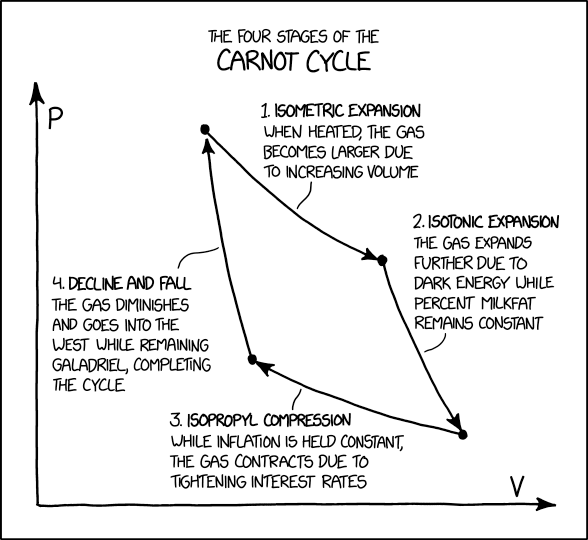
This comic shows a Pressure–volume diagram which is used in this case for a Carnot cycle, a theoretical thermodynamic cycle covered in most thermodynamics classes which looks a lot like the figure drawn. The most common example of a (suboptimal) Carnot cycle is the vapor compression cycle used in refrigerators. However in this case, Randall has replaced the labels of the 4 stages of the real Carnot cycle with new ones.
Pressure–volume diagrams were first developed to understand the efficiency of steam engines and plot the change of pressure p with respect to volume V for a specific process. The process forms a cycle and the amount of energy involved can be estimated by the area under the curve on the chart. The Carnot cycle describes the ideal efficiency that such an engine can achieve during the conversion of heat into work, or vice versa like in a refrigeration system. The real steps are called (explained in short):
- Isothermal expansion (An external heat source causes an increase of volume and an antiproportional lowering of pressure, driving the motor. It's more efficient if this step is performed slowly.)
- Isentropic expansion (The volume of the gas increases further while the pressure decreases dramatically, as the external heat source is now absent, transforming heat directly into work, lowering the Temperature. This step is more efficient, if it goes quicker.)
- Isothermal compression (External cooling and a small amount of work from another part of the machine decreases the volume of the gas and leads to the last step:)
- Isentropic compression (Now the gas is sharply compressed, using part of the work from step two to return the gas to the beginning of step one, raising the Temperature back up.)
An isothermal process is a change of a system, in which the temperature remains constant. In this diagram the volume increases (expansion) or decreases (compression). The term isentropic describes a lossless process where no heat leaves the gas, here the increased volume only causes a further decrease in pressure; it is also called an adiabatic process and is the thing which warms air when you compress it quickly. Isentropic means "doesn't cause the heat death of the universe", which is a rare thing.
The prefix iso- is derived from the Ancient Greek word ísos which translates to equal and used widely in modern days in science like here to indicate a process at the same temperature (-thermal) which is not shown in the graph. The prefix is- to the term entropy is used because isoentropic sounds stupid.
In the comic, the cycle also has two phases of expansion followed by two phases of contraction (or "decline"), but the names of steps one to three are replaced with other words beginning with the prefix "iso-" meaning same or equal, and the factors that are held constant are absurd.
Each step in this comic is explained below:
1. Isometric expansion. When heated, the gas becomes larger due to increasing volume
Isometric (literally "equal dimensions") can refer to a property or process that is symmetrical in all dimensions (i.e. the gas is expanding radially) or to a type of thermodynamic process where volume is held constant but temperature is free to vary, the exact opposite of the first step in the real Carnot cycle. Additionally, the comic text uses a circular argument (become larger due to increasing volume).
In mathematics, an isometric mapping (between metric spaces) is a map that keeps all the distances intact. If we measure the distance the same way throughout the cycle, then isometric expansion (or for that matter, isometric compression) is not really an expansion (or a compression).
2. Isotonic expansion. The gas expands further due to dark energy while percent milkfat remains constant.
Isotonic is a descriptor commonly associated with sports drinks (and not thermodynamics), which contain similar concentrations of salt and sugar as in the human body. Dark energy is hypothesized to be a cause for the accelerating expansion of the universe, which obviously isn't relevant to thermodynamics (yet). The density of milk depends on milkfat and solids-non-fat, which includes lactose. Fortified milk has increased solids-non-fat but the same percentage of milkfat, resulting in increased calories and an increased density. So the fortification of milk results in increased calories, possibly referred to as dark energy, and a contraction, as less space is needed for 1 kg of milk. However, this explanation does not match the expansion suggested in the comic.
Later Randall again combined dark energy (and also dark matter) with milkfat in 2216: Percent Milkfat.
3. Isopropyl compression. While inflation is held constant, the gas contracts due to tightening interest rates.
Isopropyl alcohol is commonly used for cleaning. Inflation and contraction could refer to changes in gas volume, but the reference to interest rates puts them in the context of macroeconomics. Raising ("tightening") interest rates tends to reduce inflation and/or "contract" the economy. High interest rates are a feature of the third stage (recession) of the Juglar cycle. In economics (and other sciences) to better understand model parameter relations, some parameter may be held constant in theory. This could refer to the Fisher equation. Holding one parameter constant is also done in the Carnot cycle (for a physical parameter): not only in theory but also in practice! (In free market economies the inflation cannot be directly held constant).
But inflation may also refer to dark energy mentioned at the isotonic expansion section above. Inflation in cosmology is a theory of the exponential expansion of space in the early universe, an effect associated with the "accelerating universe" and for which findings the 2011 Nobel Prize in Physics was given. The National Geographic blog entry Nobel Prize in Physics 2011 – The Accelerating Universe explains that "...Today, most physicists, influenced by inflation, would ... call it dark energy."
4. Decline and fall. The gas diminishes and goes into the West while remaining Galadriel, completing the cycle.
Galadriel is a character in The Lord of the Rings. She is one of the leading elves, a race that in the time of the book is said to be dwindling (in number and importance) in Middle Earth and migrating westward to Valinor. Galadriel is one of the last elves to leave, after successfully resisting temptation to take the One Ring and become an all-powerful queen who dominates Middle-earth, instead saying "I will diminish, and go into the West, and remain Galadriel." The title may be a reference to Edward Gibbon's 18th century masterpiece The History of the Decline and Fall of the Roman Empire, or to the novel Decline and Fall by Evelyn Waugh (which is itself a reference to Gibbon's book). This stage is present in the cycle because in the real cycle, at this stage, volume of the gas decreases without exchange of heat. It is the last stage after which the gas has its original value of variables, thus completing the cycle.
The title text refers to Richard Wagner and J.R.R Tolkien. Wagner's Ring Cycle consists of four operas. Tolkien wrote The Lord of the Rings, which some have suggested was inspired by Wagner's Ring. Their works are known as literary cycles.