Launch Conditions
Though I do think the tiny vent on one of the boosters labeled "O-RING" is in poor taste.
Though I do think the tiny vent on one of the boosters labeled "O-RING" is in poor taste.
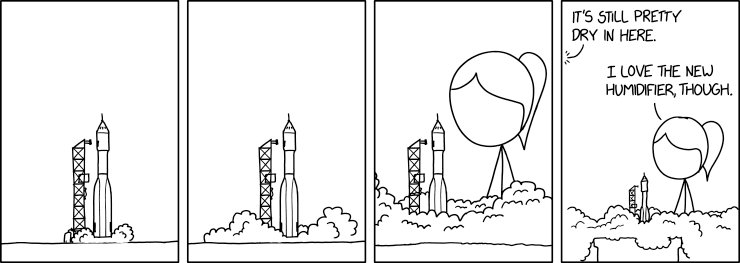
An image of a rocket (resembling a Long March 5) with a progressively larger white cloud around it is shown, but no external object for scale is visible until the third panel. It is then revealed to be a model or miniature when Ponytail walks into the shot.
The dialog reveals the miniature rocket is a domestic humidifier appliance, using its plumes of water mist to mimic the appearance of the exhaust plume of a full-size rocket.
Modern rocket launches are backed by a Sound Suppression System avoiding damages to the rocket itself, the payload, or humans inside. This system drops vast amounts of water into the exhaust of the rocket engines and the water vaporizes immediately. This vapor mainly interrupts the sound reflections from the ground. This reduces the sound to a level the rocket can withstand but also produces a big cloud of water mist. The cloud at the ground consists mostly of water and not the exhaust of the rocket engines. This article shows how the system works: NASA's Incredible Sound Suppression System Prevents Rockets from Exploding (interestingengineering.com).
Some rockets use liquid hydrogen as a fuel, especially for upper stages, so steam is the combustion product.
The title text references the failed o-ring that led to the disintegration of the Challenger Space Shuttle. The o-ring in question failed to expand at freezing temperatures, resulting in a leak of gas around the edges that was visible as a small vapor plume on the recording. The launch was pushed to a day with lower temperatures than the engineers had planned for. For the humidifier to vent the water mist from this opening is indeed in poor taste, even though the model does not resemble a shuttle.