Plutonium
It's like someone briefly joined the team running the universe, introduced their idea for a cool mechanic, then left, and now everyone is stuck pretending that this wildly unbalanced dynamic makes sense.
It's like someone briefly joined the team running the universe, introduced their idea for a cool mechanic, then left, and now everyone is stuck pretending that this wildly unbalanced dynamic makes sense.
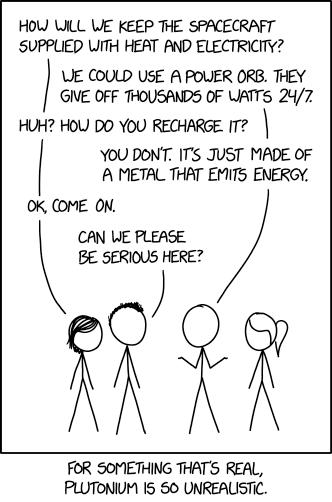
This comic pokes fun at the properties of plutonium, claiming that it is so unrealistically powerful that it may as well be random science fiction jargon. Indeed, the ability for a metal to radiate energy sounds impossible. (This comic leaves out the inherent dangers of highly radioactive material.) This is reflected by Megan and Hairy treating Cueball's idea as a joke.
There are devices that need substantial electrical power over long times – on the order of decades – but local sources of energy are insufficient or unavailable, yet constructing a power line or resupplying them with some power source (like fuel, fresh chemical batteries etc.) is either impossible or overly costly. Such devices include maritime beacons and buoys, automatic weather and science stations located in remote areas, and – most importantly – deep space probes and some planetary probes or science packs. A probe sent beyond Jupiter cannot effectively rely on photovoltaic panels for energy because the great distance to the Sun means that the amount of solar radiation per unit of area is very low, requiring impractically large and thus heavy panels to provide enough energy. Carrying a lot of fuel adds mass to the probe, making it more expensive to launch.
Instead, such devices usually use radioisotope thermoelectric generators (RTGs). In an RTG the natural radioactive decay of some unstable isotope such as plutonium-238 or strontium-90 produces a lot of heat. This is used to generate energy using thermopiles, which generate electricity directly from temperature differences using the thermoelectric effect. The key element of an RTG, a pellet of radioactive material such as plutonium dioxide, could be facetiously described as a "power orb" – a lump of a substance that gives out heat apparently from nothing. For example, the Voyager probes used three RTGs, each containing 4.5 kg of plutonium-238, each producing at its peak 2400 W of heat energy, converted to 160 W of electrical energy.
Plutonium-238 must be produced from neptunium-237 in a nuclear reactor. Neptunium-237 in turn is a "waste product" produced in comparatively large quantities (for something that is essentially real life alchemy, that is) by nuclear reactors. One problem is that in irradiated fuel, neptunium-237 will be mixed in with all sorts of other stuff and separating it is neither cheap nor easy — which is why NASA at one point was in danger of running out of it. Unlike some other radioactive materials, the alpha radiation emitted by plutonium-238 can be relatively harmless, as it is quickly absorbed by surrounding material and turned to heat. But plutonium is still incredibly dangerous if it gets inside a human body unprotected — if the "surrounding material" that turns the alpha radiation into heat is your DNA, you drastically increase your risk for cancer or get radiation sickness, depending on the dose. In pure form plutonium-238 produces a little more than half a watt of heat per gram, which slowly drops as the material decays to lead, emitting a quarter watt per gram after 100 years. Other disadvantages of RTGs include the risk of contamination in the event of a launch failure, and the relatively limited supply of plutonium.
The title text references development of games. A rule or strategy within a game is often called a mechanic, meant as one particular rule (singular) out of the overall set of rules (game mechanics). In this context, the word mechanics is a metaphor referring to the set of rules and interactions that govern the imaginary world of the game. The mechanics of a game define the deterministic or randomized functions of events and/or characters within the game, the outcomes of actions commanded by the players, and so on. This metaphor refers to the mechanics science, and how it describes behavior of physical objects in the real world. However, contrary to real-world mechanics which "just happen" and we try only to describe how things work, in game mechanics every single rule or interaction has to be explicitly defined. The game simulates (to a given extent) an actual world. Game rules do not need to mimic the real world closely and often don't for many reasons; this results in (intended or otherwise) inconsistencies, unexpected behavior or imbalance. Game players complain about “imbalance” when a particular rule, interaction or item present in the game (such as an extremely powerful magical artifact) gives a character exploiting it a great and unjustified advantage. Inconsistencies and possible imbalances can lead to problematic game mechanics being unused or left unresolved, after the creator of those mechanics ceases their participation in the game or game development process.
Things that seem like they shouldn't work but do are the main topic of 2540: TTSLTSWBD.