Lunar Cycles
The Antikythera mechanism had a whole set of gears specifically to track the cyclic popularity of skinny jeans and low-rise waists.
The Antikythera mechanism had a whole set of gears specifically to track the cyclic popularity of skinny jeans and low-rise waists.
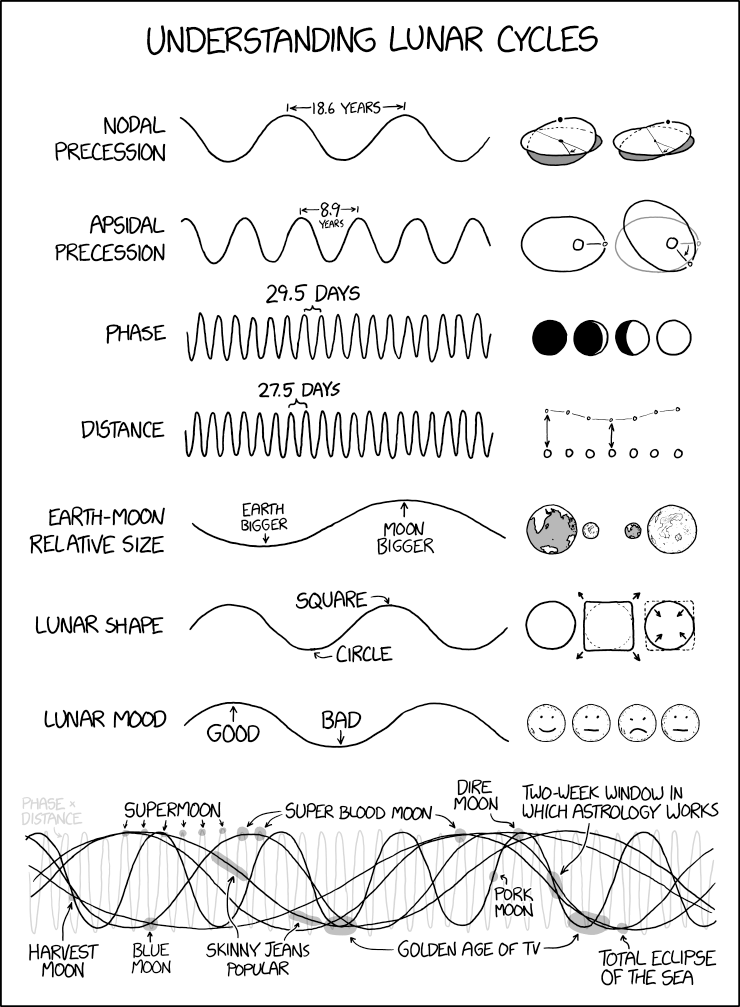
This comic shows a mixture of real, scientific lunar cycles and cycles that are comedic or fictional in nature. The first four cycles are factual, while the ones following them are not.
- Nodal precession: The Moon's orbital plane is tilted slightly compared to the Earth's orbital plane around the sun (the ecliptic). This tilt is why we don't constantly see eclipses; most of the time, the Moon's orbital plane is tilted higher or lower than the Sun, so they generally don't cross each other. The two points at which these planes do cross are called lunar nodes. Nodal precession is the gradual rotation of these nodes over time, a gyroscopic consequence of Earth's equatorial bulge. For the Moon this follows an 18.6 year cycle.
- Apsidal precession: All orbits have two points where the orbiting body is either closest to, or furthest away from, the thing they are orbiting. These points are called apsides, and the imaginary line between them is called the line of apsides. Apsidal precession is the gradual rotation of this line over time, which occurs in cycles of around 8.9 years for the Moon.
- Phase: Lunar phase describes the change in shape of the sunlit side of the Moon as viewed from the Earth's surface, which is caused by the changing angle between Moon and Sun as the Moon revolves around the Earth. The cycle of lunar phases takes 29.5 days, a figure referred to as the synodic month.
- Distance: Because the Moon's orbit around the Earth is elliptical, its distance from the Earth varies slightly over the course of an orbit. This means that the moon's distance also follows a cycle which is the same as the length of one lunar orbit: approximately 27.5 days. This figure is referred to as the anomalistic month. Note that the synodic month is (perhaps counterintuitively) two days longer than the sidereal month — or to put it another way, it takes 2 more days for the Moon's phases to cycle than it does for the Moon to go around the Earth. This is due to the fact that the Earth is also moving around the Sun while the phases are going on, which means that the Moon has to spend 2 extra days "catching up" to the point at which the lunar phase cycle can restart.
- Earth-Moon relative size: This is a joke cycle; the Earth and Moon do not physically change size, nor does the Moon ever become larger than the Earth. This may be playing on the idea that the Moon often appears to change size to viewers on Earth, due to various factors; most commonly, this is due to the Moon illusion, which tricks the brain into perceiving the Moon as much larger than it really is. There are also so-called supermoons, which occur when the full moon coincides with the Moon's closest approach to Earth; these actually do increase the Moon's apparent size, although by a relatively insignificant amount.
- Lunar shape: Again, this is a joke cycle; the Moon does not actually change shape. A shape intermediate between circle and square is known as a squircle, a subclass of the superellipse.
- Lunar mood: The moon does not have a mood, although humans can have moods that fluctuate over time, sometimes with a regularity akin to a cycle. Ironically, the section of the graph that shows a good (i.e. happy) mood has the graph line curving up then down like the mouth of a frown, and for the bad (unhappy) mood it curves down and then up, as in the mouth of a smile.
- The final diagram shows many different cycles superimposed on each other, highlighting areas where several cycles are coinciding. This is likely satirizing the media trend of overhyping astronomical coincidences and giving them grand-sounding names:
- The light gray "phase × distance" plot does not correspond to the product of periods given for phase and distance, which look like this instead.
- A harvest moon is the traditional name for the full moon closest to the autumnal equinox, but there is nothing astronomically significant about it.
- A supermoon is a full or new moon when the Moon is closest to the Earth, resulting in a slightly larger-than-usual apparent size. A full supermoon is roughly 14% larger in diameter than when the Moon is furthest away. See also 1394: Superm*n.
- A blue moon was originally a description of the very rare occurrence of atmospheric conditions that gave the Moon a bluish tinge, hence the expression "once in a blue moon" for something that happens only rarely. However, the actual blue-hued appearance of the moon is so rare that it the phrase "blue moon" has been reinterpreted as referring to a merely uncommon event: the occurrence of two full moons in a single calendar month. That kind of "blue moon" naturally does not look any different from a regular full moon.
- A blood moon refers to the moon during a lunar eclipse.
- While the popularity of skinny jeans (slim-fit pants) does change over time, the idea that this is connected to a lunar cycle is also a joke.
- The Golden Age of Television is said to have occurred in the 1940s and 50s, and the 2000s.
- Pork mooncakes have been prepared in the rural areas west of Shanghai since more than a thousand years ago, for the Chinese Mid-Autumn Festival.
- "The Vampire of the Dire Moon" is a recently introduced, uncommon card from the Magic: The Gathering card game.
- Astrology is a pseudoscience which claims that the positions of the celestial bodies can be used to predict human affairs. The chart jokingly suggests that astrology actually does work, but only within a very specific two-week timeframe.
- Finally, while the idea of a total eclipse of the sea seems absurd, an eclipse was famously used to explain the migration of maritime animals:
- biologists were beginning to unravel the mystery of this ‘false bottom’–a layer in the ocean that looks the [sic] the sea floor on the sounder but isn’t–which covered much of the ocean. This false bottom rises in up at night and sinks down during the day. This rising and falling is in fact caused by the largest migration of animal on Earth–everything from fish, shrimp and jellyfish, moving hundreds of meters in unison up and down each day.... the moon moved into its place in front of the sun, daylight rapidly faded, and the scientists solved the migration mystery: the deep layer of animals began to rise. Bioluminescent creatures started to shine, and nocturnal creatures started a frantic upward thrust. As the world grew darker, they swam upward nearly 80 meters. But this frantic migration didn’t last long. As the moon receded and the sun revealed itself, the massive animal layer did an about-face, scrambling back into the safety of the darkness.
- (Backus, Clark, and Wing (1965) "Behaviour of certain marine organisms during the solar eclipse of July 20, 1963" Nature 4975:989-91.)
The Antikythera mechanism mentioned in the title text is an ancient Greek machine, rediscovered in 1901, designed to calculate astronomical positions. The title text jokes that there is a set of gears on said mechanism that is used to predict the popularity of "skinny jeans" and "low-rise waists." Since it was likely created in the 1st or 2nd century B.C.E., it is impossible for the creators to have had any knowledge of skinny jeans or low-rise waists - both are modern-day clothing fashions.[citation needed] "Total eclipse of the sea" may also refer to the song "Total Eclipse of the Heart".
