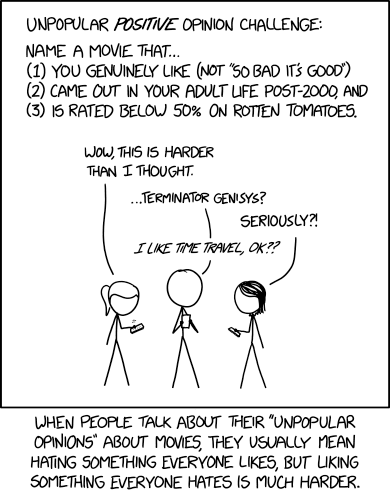
Everybody has their own preferences as to what movies they like and dislike, and when your like or dislike of a movie seems to be different than the majority of people, you could call your preference the "unpopular opinion" because your opinion is the less prevalent one. This most often takes the form of "I hate this movie and I don't understand why everybody else seems to like it", but this comic is talking about the opposite form, which it categorizes as less common, namely "I like this movie and don't understand why everybody else seems to hate it." The comic points out that it's relatively common to hate movies that most people like, but the converse, in which you like a movie others seem to hate, is much harder to find. One explanation for this may be that if a movie is already established to be bad, you won't end up watching it anyway.
To illustrate this point, the comic challenges readers to identify such a movie, with three caveats: it came out during your adult life, you genuinely like it, and it scored below 50% on the popular review aggregator {w|Rotten Tomatoes}}. The first two conditions are selected to eliminate the most common reasons people might like "bad" movies. Movies we see as children may win our affection despite not being very good, both because children tend to have less discriminating tastes, and because we associate them with happy memories, causing us to enjoy them as adults, despite their flaws. Some movies are enjoyed specifically because they're so bad, and people find humor or morbid fascination with the terrible filmmaking (referred to as "So Bad, It's Good"). Both those cases are distinct from a film that an adult would actually enjoy on it's own merits.
The third condition is intended to ensure that the movie is genuinely unpopular (or at least critically maligned). It's possible for people to have a perception of how disliked a movie is (possibly due to your own social circle), which doesn't actually represent large-scale popularity. The condition also eliminates films which weren't actually disliked, but just weren't as popular as you think they should have been. Rotten Tomatoes aggregates professional reviews and categorizes them as positive ("fresh") or negative ("rotten"). Scoring below 50% means that less than half of all reviewers gave the film a positive review, which is a good proxy for a film being generally understood to be "bad". It's worth noting that audience ratings don't always align with professional critics, so this isn't a perfect test for popularity, but it's a decent match.
The image in this comic gives an example of this effect, namely the movie Terminator Genisys, the fifth in the Terminator series, released in 2015. This series, about time-traveling killer robots, included the highly rated Terminator 2 (93% on Rotten Tomatoes), while Terminator Genisys is only 26%. When Cueball says he likes the movie, Megan is surprised (possibly appalled) causing him to become defensive. This may indicate another difficulty in expressing such opinions: other people may look down on you for your perceived bad taste.
The title text refers to three movies in the Terminator franchise, Terminator 3: Rise of the Machines (2003), Terminator Salvation (2009), and Terminator: Dark Fate (due out later in 2019). The Terminator movie series has featured both time travel and trucks driving or attempting to drive into people, and Randall apparently finds himself drawn to such movies. He hopes that Dark Fate will be a good movie, but has low expectations, considering the less than stellar ratings of the last 3 movies (69%, 33%, and 26%).
A Rotten Tomatoes search ordered by release date limited to qualifying movies (except that it goes up to 60%) can help individuals verify the difficulty of finding such movies for themselves.