Dark Matter
To detect dark matter, we just need to build a bird feeder that spins two squirrels around the rim in opposite directions at relativistic speeds and collides them together.
To detect dark matter, we just need to build a bird feeder that spins two squirrels around the rim in opposite directions at relativistic speeds and collides them together.
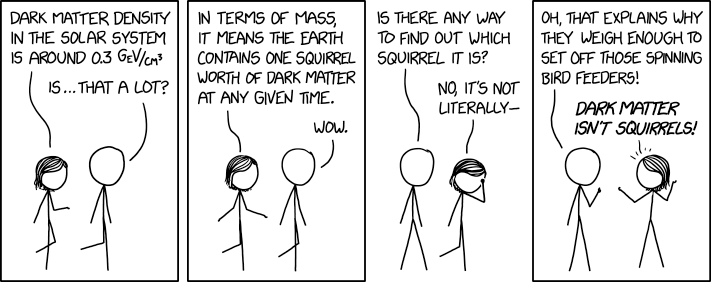
Megan and Cueball are talking about dark matter, the mysterious invisible mass observed indirectly by the rate at which galaxies rotate. Megan states that dark matter's density in the solar system is 0.3 GeV/cm3, as claimed, for example, by Bovy and Tremaine (2012) "On the local dark matter density" in The Astrophysical Journal. Cueball does not understand what that means, so Megan explains that it equates to one squirrel's mass of dark matter in the volume of the Earth. In the final two panels, Cueball humorously misinterprets this as implying dark matter is actually one or more squirrels, and thereby provides the mass which causes squirrels to spin on bird feeders designed to deter them while birds, with lower mass, do not. This enrages Megan.
The gigaelectronvolt (GeV) is a unit of energy that can be converted to a mass using Einstein's formula E = mc2. It is typically used for subatomic particles, such as weakly interacting massive particles (WIMPs), one of several contending possibilities for the still-open question of the composition of dark matter, and one which Megan's uniform density figure implies constitutes most of it. For example, the mass of a proton is 0.938 GeV/c2. However, it is common to omit the c2 denominator, representing masses as GeV or MeV. A mass represented as 0.3 GeV is equal to 5.35 × 10⁻²⁵ grams [1]. Since the Earth's volume is 1.083 × 1027 cm3 Megan's figures imply that a squirrel has a mass of about 1.3 lb (1.083 x 5.35 × 1027−25 g = 580 g [2]), a typical weight for several species of common squirrels.
Squirrels are a recurring topic on xkcd, but are not a serious alternative to WIMPs as a scientific explanation for the composition of dark matter. Since the September 2015 detection by the Laser Interferometer Gravitational-Wave Observatory (LIGO) and subsequent confirmation by the Virgo interferometer of gravitational waves from unexpectedly many merging black holes substantially more massive than those produced by stellar collapse, primordial black holes (PBHs) have become a popular alternative explanation to WIMPs (or squirrels), attracting proponents at NASA, and other cosmologists for several reasons. But PBHs remain controversial, because if they constituted more than a very small portion of dark matter, alternative explanations would be almost entirely excluded.
Other alternative hypotheses for the observations suggesting dark matter, such as theories involving the gravitational force varying over different distances, often upset cosmologists as much as Megan is shown to be, because they violate the cosmological principle among other issues. Part of this frustration may be due to the fact that even after many decades of careful, tremendously expensive, and often stunningly beautiful experiments, none of the many explanations for dark matter or the observations suggesting it have as yet any support from direct empirical observations.
To help resolve this mystery, the title text imagines using a spinning bird feeder like a particle accelerator, colliding squirrels at relativistic speeds as if they were subatomic particles, to detect dark matter particles like the CERN accelerator discovered the Higgs boson. (Note, however, that accelerating even one squirrel to relativistic velocities would destroy the feeder along with any nearby birds, not to mention the squirrels, and the surrounding city.)
2035: Dark Matter Candidates lists a spectrum of dark matter candidates by size. An oracle reveals that dark matter particles mass 3085: About 20 Pounds - pretty chunky for a squirrel.