I Love the 20s
Billboard's "Best of the 80s" chart includes Blondie's 1980 hit "Call Me." QED.
Billboard's "Best of the 80s" chart includes Blondie's 1980 hit "Call Me." QED.
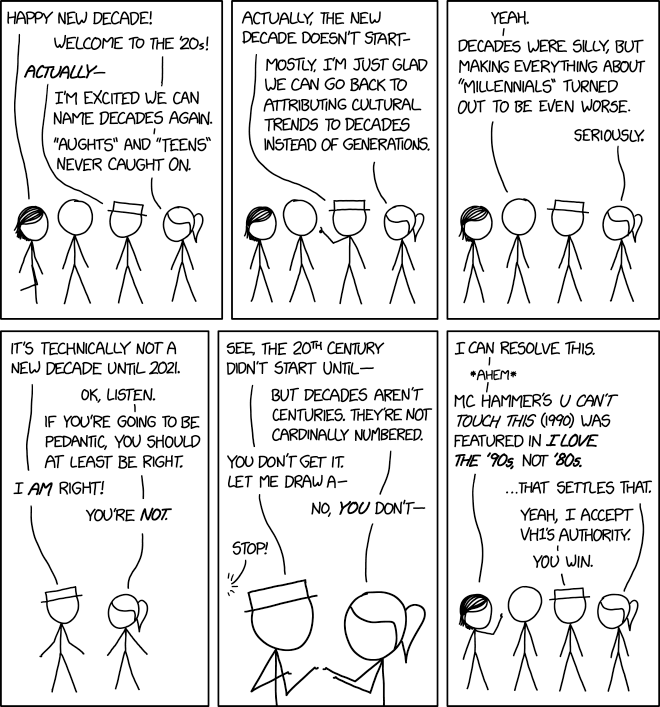
This comic was released on the first day of the year 2020. It was the second of two New Year comics around the 2019-2020 New Year, after 2248: New Year's Eve.
The comic opens with Megan, Cueball, White Hat, and Ponytail celebrating the new year. Ponytail expresses relief that, they can now unambiguously name the decade "the 20s", since the decade has a well-defined name, any cultural trends that begin in the 20s can be attributed to the decade itself, and not to the generation that happens to coincide with it.
Prior to 2000, and particularly in the latter half of the 20th century, eras were often defined by decades, such as discussing the social movements of the 60s, or the music of the 80s. Beginning in 2000, this trend was noticeably reduced, most likely because the first two decades of a century didn't fit into the same naming convention, making it clunkier to discuss. "Aughts" and "Teens" were names suggested for the 2000s and 2010s respectively; however, neither of those names managed to gain widespread acceptance.
In this same era, there was an increased emphasis on generational cohorts, which Ponytail seems to see as a replacement for dividing time into decades. Millennials is a name given to the generation which was born in the 1980s through the mid 1990s. The term is sometimes used pejoratively by older generations who view millennials as immature or complacent, and this was particularly common in the 2010s. It's possible that this focus on the generation was really a substitute for a focus on youth culture of that era. This is particularly notable since, as time moves on, Millenials continue to age, but the older generation still views them as the current youth. This phenomenon was previously discussed in 1849: Decades.
White Hat, however, raises a pedantic objection to Ponytail's celebration: he believes that the new decade does not properly start until 2021.
Ponytail corrects him on this, but he refuses to accept the correction until Megan cites an unlikely source: the fact that the VH1 television show I Love the '90s categorized MC Hammer's 1990 single "U Can't Touch This" as a 90s song, which supports Ponytail's definition of a decade. The joke is that a pop culture documentary is not an authoritative source for definitions of time standards,[citation needed] yet everyone is willing to immediately accept its authority on such matters anyway. Demonstrating the common usage of language is a valid argument, but the degree to which the authority of a single cable channel resolves the argument is unexpected.
The disagreement over the definition of when decades start is due to the fact that there is more than one way to count decades. You could do it in one of the following two ways:
- By counting every span of ten years that has occurred since the start of year 1 in the Common Era (White Hat's definition)
- By taking the digit that is common to all years in a given ten-year span (Ponytail's definition)
White Hat's definition is an "ordinal" method since it functions by counting the number of ten-year spans since the first one, which is defined to have begun in the year 1. However, Ponytail's definition is the "cardinal" method, which simply groups years by their common most significant digits. For example, when we say "the 1980s", we mean "the span of ten years that all began with the digits 1-9-8".
Both definitions are internally consistent, but Ponytail's definition is clearly the more common one. She notes that this is not how decades are typically determined, and the fact that counting centuries in an ordinal way does not require that the same be done for decades.
White Hat's objection recalls an issue that was frequently discussed around the year 2000. Like decades, centuries may be counted ordinally ("20th century", "19th century", etc.) or cardinally ("1700s", "1600s", etc.). Unlike decades, the ordinal terms are always used for centuries in most languages, including English (except informally). Thus, much of the world celebrated the year 2000 as the start of the 21st century and of the third millennium, even though this was incorrect.
Megan's exclamation "Stop!" is similar to the line famously used by MC Hammer in "U Can't Touch This" ("Stop! Hammer time.").
Continuing the dubious "proof" offered by Megan, the title text goes on to use the Billboard Best of the 80s chart as proof that the 1980s started in 1980, as their chart includes Blondie's "Call Me", which was released in 1980. The title text ends with QED ("quod erat demonstrandum"), which means "which was [necessary] to be shown", and is traditionally used at the end of a mathematical proof, implicitly equating such pop culture references to unassailable logical evidence.