RIP John Conway
1937-2020
1937-2020
John Conway, an English mathematician, passed away of COVID-19 on April 11, 2020. (Alternative link) Two days later, Randall created this memorial comic. It is the 6th memorial comic, but it is the first released in almost 5 years, since 1560: Bubblegum. Conway's most famous creations was the cellular automaton known as Conway's Game of Life. A cellular automaton is a machine composed of cells, each of which can be in a different state. Every generation, each cell in the automaton may transition to a new state depending on a set of rules. (Conway's work in mathematics was vast and various, but he is perhaps best known in the field for discovering the surreal numbers, which inspired Donald Knuth to write a novel which may have been referenced back in 505: A Bunch of Rocks.)
Conway's Game of Life was first popularized to the general public in the form of a game, Life Genesis, bundled into some distributions of Windows 3.1, an operating system from the early-90s that Randall most likely used in his preteen years. Conway's Game of Life is a 2-state automaton (i.e., every cell can be "alive" or "dead") that is implemented on a two-dimensional grid of cells using the Moore neighborhood - this means that each cell can only be influenced by the eight cells directly surrounding it, both orthogonally and diagonally. The transition rules that Conway used are as follows:
- If an "alive" cell has no live neighbors, or only one live neighbor, it becomes "dead". (This simulates death by isolation).
- If an "alive" cell has four or more live neighbors, it becomes "dead". (This simulates death by overcrowding).
- If a "dead" cell has exactly three live neighbors, it becomes "alive". (This simulates birth).
Despite the simplicity of these three rules, Conway showed that patterns of amazing complexity can nonetheless develop out of simple cell arrangements. Some patterns do not evolve at all ("still lifes"), some enter a cyclic, repeating state ("oscillators"), and some reproduce their own pattern displaced by an offset, resulting in patterns that can move across the grid under their own power ("gliders" and "spaceships"). This last category is of particular interest, as it allows the Game of Life to transmit information from one location to another, allowing for rich, dynamic behavior and even for the creation of computational machines within the automaton itself.
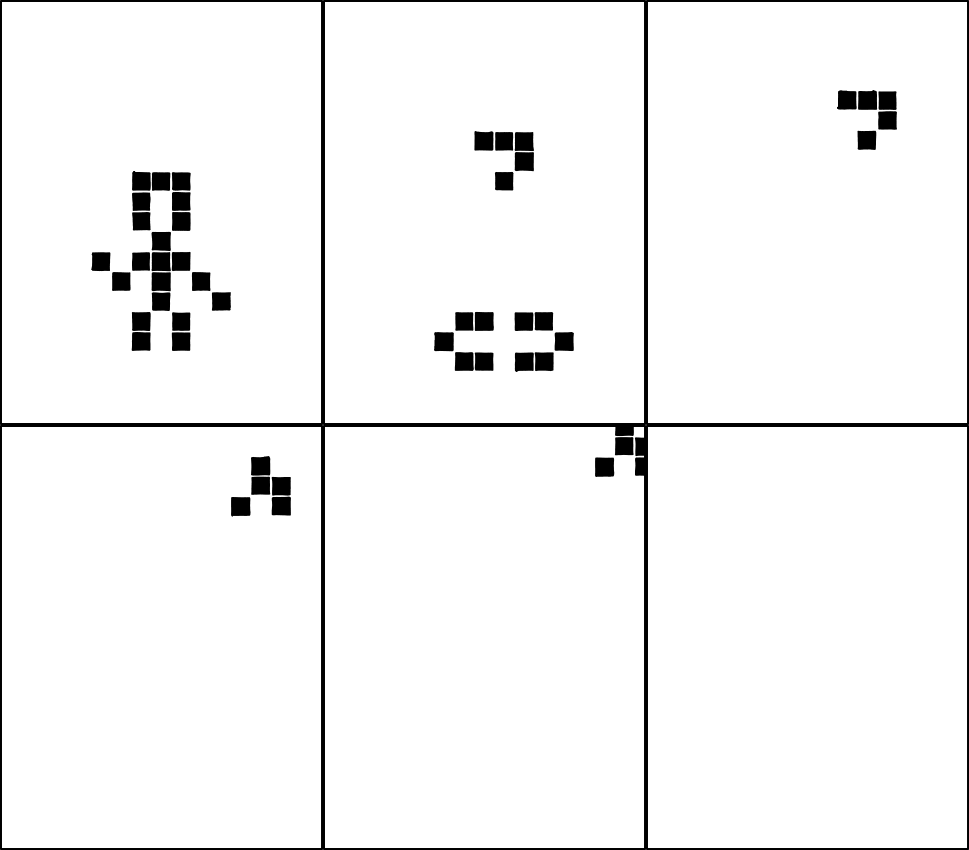
This comic begins with the shape of a stick figure as the starting cell configuration of the Game of Life. The black cells are "alive" and the white cells are "dead". This configuration then evolves via Conway's rules, disintegrating into nothingness except for a five-cell pattern known as a "glider", which ascends up and to the right. This visually suggests an eternal "soul" breaking away as the corporeal body disintegrates. The glider is perhaps the most iconic pattern of the Game of Life, and is often used symbolically to represent the phenomenon of emergence.
Here the topology of the grid on which the cells evolve is not known, the cellular automaton can be run on many topologies, for example you can choose to make cells reappear from the opposite side once they reach an edge (similarly to the behaviour of the well known Pacman). Here once the glider reaches the top right, we know for sure that the actual grid is bigger (since the glider leaves the frame while continuing its pattern), and we are only seeing part of the full grid.
The initial state presented in the comic does actually evolve in that manner, as can be verified by entering the pattern into a cellular automaton simulator such as Golly or web services such as this one or that one. It seems that no one else have created this pattern before. At least, despite discussion in the comments, no one has found anything to show that this is not Randall's own discovery of this pattern.
The title text simply states Conway's birth and death year: 1937-2020. Conway's Game of Life was previously mentioned in 696: Strip Games. Cellular automata was also referenced in 505: A Bunch of Rocks.
This comic is the 18th comic in a row (not counting the April Fools' Day comic) in a series of comics related to the COVID-19 pandemic. Although this comic is, of course, mainly a tribute to John Conway, the fact that he died of COVID-19 in the middle of this long series of coronavirus-related comics by Randall is relevant.
Generations
Starting state (or "zeroth generation").
First generation. Note that this image is not aligned with the previous one: the position of all cells has shifted downward by one cell. All further generations are aligned the same as this one.
Second generation.
Third generation.
Fourth generation.
Fifth generation.
Sixth generation. The first appearance of the glider, a well-known formation in Conway's Game of Life.
Seventh generation. The glider takes on its other shape.
Eighth generation. The glider returns to its first shape, pointing right instead of up.
Ninth generation. The glider's second shape again, pointing right instead of up.
Tenth generation. The glider is now in its original form, but one cell higher and one cell to the right. It will continue to progress, cycling through these four states every four generations. The remains of the chaos down below will take two more generations to disappear completely.


