Historical Dates
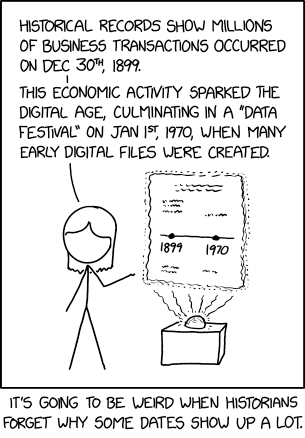
Evidence suggests the 1899 transactions occurred as part of a global event centered around a deity associated with the lotus flower.
Evidence suggests the 1899 transactions occurred as part of a global event centered around a deity associated with the lotus flower.
Many files and database entries contain a date. When it is not set, it often defaults to the first day in the system. The two dates listed below are mentioned as "significant" in the comic.
Dec 30th, 1899
Dec 30th, 1899 comes from a spreadsheet date compatibility issue between Excel and Lotus 1-2-3 (referenced in the title text.) Spreadsheets store dates as sequential numbers so that they can be used in calculations. In Excel, by default, January 1, 1900 is number 1 [1]. Based on that, Excel's integer date representation would be the number of days that have passed since December 31, 1899. However, because of a bug intentionally carried over from Lotus 1-2-3 where it counts February 29, 1900 as a day even though it actually was not [2], for any day since then, Excel's integer date representation is actually the number of days that have passed since December 30, 1899. Most other spreadsheet applications copied the behavior of Excel to maintain compatibility with it. This leads to the value of 0 in some applications (notably Open- and LibreOffice Calc and Google Spreadsheets) being interpreted as Dec 30th, 1899. Similarly, Microsoft Visual Basic and Visual Basic for Applications (VBA) interpret 0.0 as Dec 30th, 1899.
The historian in the comic presents some research wrongly based only on the number of entries created on those dates. This confusion on the part of the future historian only grows in the title text, where they make the claim that Lotus 1-2-3 is, in fact, religious imagery related to some sort of deity, potentially a lotus god, around whom the '1899 event' took place. This may be poking fun at the trope that anthropologists attribute any behavior they can't explain to religious ritual.[actual citation needed] This historian's confusion may have been at least partially due to China's White Lotus Religion.
Jan 1st, 1970
Many operating systems and software store dates as Unix timestamps, which are defined as the number of seconds since Jan 1st, 1970, 0:00 UTC. When data entry neglects to provide a value, the system may be programmed to treat it as 0; consequently, an unprovided timestamp value is interpreted as Jan 1st, 1970 thereby creating the illusion of an "activity spike" on that date.