Y2K and 2038
It's taken me 20 years, but I've finally finished rebuilding all my software to use 33-bit signed ints.
It's taken me 20 years, but I've finally finished rebuilding all my software to use 33-bit signed ints.
 An animation of the 2038 bug in action. The integer overflow error occurs at 03:14:08 UTC on 19 January 2038.
The Y2K bug, or more formally, the year 2000 problem, was the computer errors caused by two digit software representations of calendar years incorrectly handling the year 2000, such as by treating it as 1900 or 19100. The year 2038 problem is a similar issue with timestamps in Unix time format, which will overflow their signed 32-bit binary representation on January 19, 2038.
While initial estimates were that the Y2K problem would require about half a trillion dollars to address, there was widespread recognition of its potential severity several years in advance. Concerted efforts among organizations including computer and software manufacturers and their corporate and government users reflected unprecedented cooperation, testing, and enhancement of affected systems costing substantially less than the early estimates. On New Year's Day 2000, few major errors actually occurred. Those that did usually did not disrupt essential processes or cause serious problems, and the few of them that did were usually addressed in days to weeks. The software code reviews involved allowed correcting other errors and providing various enhancements which often made up at least in part for the cost of correcting the date bug.
It is unclear whether the 2038 problem will be addressed as effectively in time, but documented experience with the Y2K bug and increased software modularity and access to source code has allowed many otherwise vulnerable systems to already upgrade to wider timestamp and date formats, so there is reason to believe that it may be even less consequential and expensive. The 2038 problem has been previously mentioned in 607: 2038 and 887: Future Timeline.
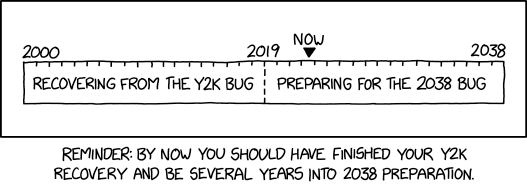
This comic assumes that the 38 years between Y2K and Y2038 should be split evenly between recovering from Y2K and preparing for Y2038. That would put the split point in 2019. The caption points out that it's now, in 2022, well past that demarcation line, so everyone should have completed their "Y2K recovery" and begun preparing for year 2038. It is highly unlikely that there are more than a very few consequential older systems that still suffer from the Y2K bug, as systems built to operate this millennium handle years after 1999 correctly. The topic of whether or not Y2K was actually as big of a problem as it was made out to be remains hotly debated. The main arguments falling into the general camps of "nothing bad happened, Y2K would have overwhelmingly been an inconvenience rather than a problem" vs. "very little happened only because of the massive effort put into prevention". It is unlikely that there will ever be a conclusive answer to the question, with the truth probably being somewhere in between those two extremes. Whatever the answer to that question may be, the reaction to Y2K did result in a significant push towards, and raise in public awareness of, clean and futureproofed code.
The title text refers to replacing the 32-bit signed Unix time format with a hypothetical new 33-bit signed integer time and date format, which is very unlikely as almost all contemporary computer data structure formats are allocated no more finely than in 8-bit bytes. Doing this may seem complicated to new software developers, but recompiling with a larger size of integers was a normal solution for the Y2K bug among engineers of Randall's generation, who learned to code when computer memory space was still at a premium. For example, in most implementations of the C language, the data type that represents 32-bit integers is called "long", while a 16-bit integer is a "short". C actually does allow programmers to declare a 33-bit integer ("long long:33"), but they're really just treated as 64-bit numbers that get truncated when stored, and would be slow unless running on custom hardware that supports such a type natively (which no hardware currently does). Taking 20 years to develop and implement such a format is not entirely counterproductive, as it would add another 68 years of capability, but it is a far less efficient use of resources than upgrading to the widely available and supported 64-bit Unix time replacement format and software compatibility libraries.
