Faucet
It's okay, they can figure out which control positions produce scalding water via a trial-and-error feedback loop with a barely-perceptible 10-second lag.
It's okay, they can figure out which control positions produce scalding water via a trial-and-error feedback loop with a barely-perceptible 10-second lag.
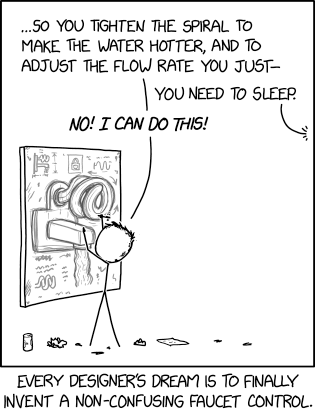
A variety of faucet controls have been designed for the control of a shower or sink's water output; however, Randall seems to find all the existing options to be inadequate in some way and posits in this comic that designers share a desire to create a more ideal design. The comic shows one such designer, looking unkempt and rambling like a madman as he explains to an off-screen character how his new faucet design works. The off-screen character promptly tells him that he should get some sleep, a request which the designer ignores in favor of continuing the search for the "perfect" water faucet.
In general, a faucet's output has two independent parameters: flow velocity and temperature; some particularly frustrating faucet controls only offer one degree of freedom which simultaneously turns up the flow rate and the temperature, and thus cannot fully explore the shower-space (making it sometimes difficult to find a comfortable setting). Some faucets can adjust both parameters but only have a single lever which must be angled along degrees of freedom which are not always labeled clearly or intuitively, and this may also irk Randall. Other faucets have two independent controls for the flow of cold water and hot water; however, while these are highly granular, it can be difficult to adjust the parameters independently e.g. change the temperature without changing the flow, or changing the flow without changing the temperature.
While two-handle faucets may seem simple in the abstract, they are imperfect in practice. In older houses or those with hot water systems based on tankless or instant hot water heaters, the hot water pressure is rarely the same as the cold water pressure. This can cause problems with cold water flowing back into the hot line, creating temperature drifts, unexpected changes in temperature based on slight input changes, and non-reproducibility in shower settings.
Newer systems include thermostatic mixing valves which are designed to alleviate these problems; ideally, they contain one control for temperature and one for flow, which would seem to fit the "non-confusing" brief and solve Randall's problems. However, designing a system technically functional and making it intuitive (and making it work in practice for all water supply systems) is non-trivial, so Randall may have had trouble with even these faucets in the past.
The experience of a shower being affected by a significant change in usage of water elsewhere in the building (a running washing machine clicking into or out of a rinse-cycle, or the sudden use of a flush-toilet) is a typical one in any place without deliberately over-engineered plumbing. Purpose built hotels may have an in-built degree of resilience of this kind, but over many temporary stay-overs by guests (each new set having to become familiar with the plumbing) will develop wear and tear that later guests will not be automatically aware of — including the gradual wearing off of the traditional red and blue arrows intended to show the polarity of hot-and-cold controls.
The title text is a hyperbolic and slightly sarcastic explanation of the merits of a faucet system, presumably from its designer. It describes that the user can identify an undesirable result, e.g. of scalding water, through a trial-and-error feedback loop. But, with a decidedly long delay in response time as the scalding (then non-scalding) mix works its way through the system, it means that they are left waiting for any adjustments made to prove themselves as useful (or not) whilst still experiencing the prior state of the water.