Electron Holes
They tried to report me to the authorities, but because I had the device they couldn't charge me.
They tried to report me to the authorities, but because I had the device they couldn't charge me.
An electron hole is a quasiparticle denoting a lack of an electron. These are fundamental in the theory and design of semiconductors and discussed in many educational tracts regarding electronics engineering. Referring to a beam by what it seems to be doing in simplistic terms is not typical terminology;[citation needed] otherwise we might refer to "shadow beams" instead of "destructively interfering photon beams" and a "nonmagnetic field" instead of a "magnetically shielded" space. It should be noted, however, that the equivalent of a hole in the QED vacuum is a real particle known as the positron. See the Dirac sea.
Wikipedia gives a good basic explanation of the concept of the "electron hole":
[A]n electron hole (often simply called a hole) is a quasiparticle denoting the lack of an electron at a position where one could exist in an atom or atomic lattice. Since in a normal atom or crystal lattice the negative charge of the electrons is balanced by the positive charge of the atomic nuclei, the absence of an electron leaves a net positive charge at the hole's location.Holes in a metal or semiconductor crystal lattice can move through the lattice as electrons can, and act similarly to positively-charged particles. They play an important role in the operation of semiconductor devices such as transistors, diodes (including light-emitting diodes) and integrated circuits. If an electron is excited into a higher state it leaves a hole in its old state. . . .
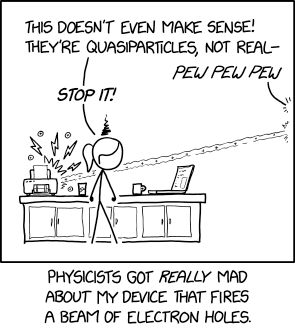
In solid-state physics, an electron hole (usually referred to simply as a hole) is the absence of an electron from a full valence band. A hole is essentially a way to conceptualize the interactions of the electrons within a nearly full valence band of a crystal lattice, which is missing a small fraction of its electrons. In some ways, the behavior of a hole within a semiconductor crystal lattice is comparable to that of the bubble in a full bottle of water.In this cartoon, the physicist is upset that the idea of the electron hole beam doesn't "make sense" – because a beam consisting purely of things that are "missing" doesn't seem possible; electron holes only exist in the context of a background field of electrons in which just a few are missing. Thus, an "actual" ray would have caused a travel of electrons in the opposite direction– yet the beam is still working to destroy her belongings (or at least create dramatic visual effects). Eventually she resorts to simply exclaiming "Stop it!", humorously more due to the beam being made of quasi-particles than because it's destroying her belongings.
The caption below the comic states that physicists, plural, were angry about this device, implying that this is not the first physicist whose lab he has interfered with. Considering his history of having silly hobbies and that he mentions it is his device in the caption, it must be Randall who managed to create this device. The physicists are also likely more angry that they are being attacked by quasi-particles somehow, instead of just being attacked by comparatively conventional weapons.
The title text plays on a double meaning of "charge". In the comic panels, "charge" refers to an electric charge. When the word is used with "authorities", it's an accusation. However, the title implies that his device can not only negate the ability to apply an electric charge (by recombining the applied electrons with his "electron holes"), but can also prevent the authorities from applying the legal sort of "charge" to him – perhaps by creating even-more-outlandish "prosecution holes".