Redshift
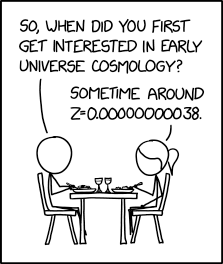
So do you have any plans for z=-0.000000000000045?
So do you have any plans for z=-0.000000000000045?
In this comic, Ponytail is using cosmological terms to answer that she first got interested in early universe cosmology 5.4 years ago, to which Cueball asks (in the title text) whether she has plans five and a half hours later. One interpretation is that these are two colleagues out for lunch, and Cueball likes her nerdy answer so much he wants to ask her out for a dinner date after work.
In observational cosmology, a field of astronomy, redshift refers to the way that light from distant objects in the universe is stretched out, making it appear more red than it would otherwise. This occurs because the universe is expanding, and as a result, light waves are stretched as they travel through space. The "z" value is a dimensionless measure of the redshift: the observed wavelength minus the expected wavelength, divided by the expected wavelength. A higher "z" value, or redshift, corresponds to earlier times in the history of the universe. This is because as the universe expands, light from distant galaxies is stretched to longer, redder wavelengths as it travels towards us. The further away a galaxy is, the longer its light has been traveling, and thus the more the universe has expanded since that light began its journey. Therefore, a higher redshift indicates a galaxy that is further away and that the light we see from it left when the universe was younger. Conversely, a lower redshift means the light has traveled a shorter distance and time, indicating a more recent epoch in the history of the universe. Negative values of "z" indicate a blueshift, which indicate objects that are approaching the observer, generally used in cosmological work to calculate rotation speeds of closer objects.
The joke here is that Cueball is asking Ponytail when she became interested in cosmology, and instead of giving a conventionally referenced time (such as "in college", "as a kid", "in 2020" or "seventeen years ago", whatever may apply), she responds with a redshift value "z=0.00000000038". This very small number corresponds to a very recent event compared to the start of the universe; well within a human lifetime, though it might take a cosmologist's specific knowledge to understand this and work out the interval's value. The negative blueshift question in the title text is a playful way of similarly asking about a future event. As the absolute value of the negative z is about ten thousand times smaller, it indicates a much closer event in the future.
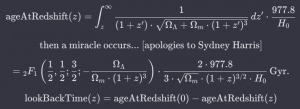 Calculation of look-back time is based on redshift, the Hubble parameter H0, and the cosmological parameters for mass Ωm and dark energy ΩΛ. The suprisingly extant closed-form solution of the integral includes the special Gaussian hypergeometric function 2F1.
Assuming a given cosmology, its curvature, and a value for the Hubble parameter H0 (also called the Hubble constant), it is possible to derive a specific look-back time for any given redshift value. For z=0.00000000038, a flat Lambda-CDM cosmological model with H0 = 69.32 km / Mpc / s (a reasonable medium between the disparate "crisis in cosmology" values for the Hubble parameter), a value of Ω0 of 0.2865, and a cosmic background temperature of 2.725 K, the look-back time is about 1960 days, or 5.4 years, which could suggest that Ponytail started studying cosmology as part of a Ph.D. program. Negative numbers of z, such as in the title text, would indicate a "look-forward" time, or a time in the future, and the same model indicates that z=-0.000000000000045 corresponds to 5.5 hours in the future. So Cueball is likely asking something like "What are you thinking of doing (later) this evening?"
The use of non-standard units of measurement has also been seen in 2707: Astronomy Numbers, with much larger typical redshift values previously included in 2764: Cosmological Nostalgia Content. Redshift and blueshift have also been mentioned before in 1852: Election Map.


