Materials Scientists
If a materials scientist gives you a present, always ask whether regifting will incur any requirements for Federal paperwork.
If a materials scientist gives you a present, always ask whether regifting will incur any requirements for Federal paperwork.
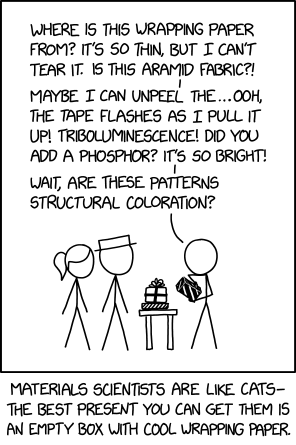
Materials science is essentially the study of materials, like steel, including some pretty strange ones such as Vantablack and triiodide. Here Ponytail and White Hat have given Cueball (a materials scientist) some sort of present. Cueball is amazed with the wrapping paper and tape itself, trying to make out what they are all made of. The caption reveals that the cardboard box is empty and the wrapping paper is the present; as a materials scientist, Cueball is more enamored by the (strange and exotic) wrapping paper, far more than he would be by any actual present inside.
The punchline also compares Cueball to a cat. A common stereotype (with lots of image proof, to boot) about domestic housecats is how they enjoy playing with empty boxes and discarded wrapping paper much more than the cat toys contained therein.
Aramid fibers are a class of strong synthetic fibers, built from aromatic rings connected via amide linkages. Kevlar, a material commonly and perhaps most famously used as a bullet-resistant fabric for soft bulletproof vests, is an example of an aramid. Due to their strength, they can be quite durable, even when thin, as depicted in the comic.
Triboluminescence refers to a phenomenon where mechanically working on a material (in this case pulling on the tape) causes it to glow. Triboluminescence is still not well understood by materials scientists, so they may find such materials particularly appealing. One famous example comes from crushing Wint-O-Green Lifesavers mints, which creates particularly bright blue sparks compared to other hard candies. Staying in the realm of wrapping, Scotch tape exhibits this property too, to a point where it can even be used as an x-ray. Phosphors, not to be confused with the element Phosphorus, are substances that glow when exposed to some other, typically more energetic, form of radiation, and can be used to produce a desired glowing effect by taking less useful parts of the spectrum (e.g. beyond the visible, or in an unnecessary area of the visible one) and shifting that into more practical hues.
Structural coloration is a phenomenon where the coloration of an animal or plant is not produced via pigments but via structural interactions with visible light at the scale of a wavelength (e.g. diffraction gratings, thin-film interference). More generally, it can also be used to refer to artificial materials that have a similar effect.
The title text states that if a materials scientist gives you a gift, you should ask if regifting it requires any form of federal paperwork. This is because the materials scientist may have access to items which are dangerous and strictly regulated, such as polonium (an extremely radioactive element), fluoroantimonic acid (the strongest acid discovered), nitrogen triiodide (one of the most sensitive explosives in the world), and n-butyllithium (an extremely flammable, pyrophoric, and caustic compound). Other examples include materials regulated for military reasons under ITAR, possibly up to being considered sensitive or top secret, such as high tech fibers, composites or other such materials with applications for armor (covered under e.g. CFR, Title 22, § 121, Category XIII (e)), or basically anything that has use in rockets (e.g. § 121 Catergory XIII (d)) or stealth (e.g. § 121 Catergory XIII (g) and (j)). All of those are at least export restricted, and require federal paperwork to be regifted or sold.