Rebuttals
The mainstream dogma sparked a wave of dogmatic revisionism, and this revisionist mainstream dogmatism has now given way to a more rematic mainvisionist dogstream.
The mainstream dogma sparked a wave of dogmatic revisionism, and this revisionist mainstream dogmatism has now given way to a more rematic mainvisionist dogstream.
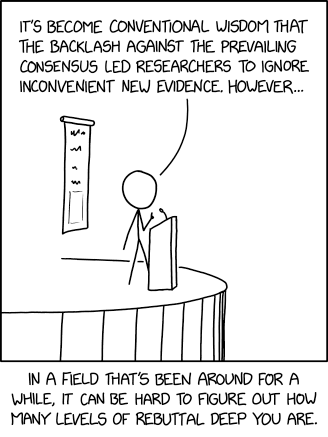
In the comic, Cueball is giving a lecture to present a scientific result in a long-standing field of study. He prefaces his speech by explaining the context of his research, but since the field has been around for a long time, the context is quite convoluted.
Here is a simplified version of what Cueball is saying:
"Most of us now assume the following: That when a lot of people didn't agree with what most experts said, the researchers stopped paying attention to new facts that didn't fit their ideas. But actually..."The "backlash" that Cueball is referring to could be from the public, other researchers in the field, or both. If at least some part of the backlash comes from other researchers, then the researchers who "ignore inconvenient new evidence" could be those who support the prevailing consensus, or those who do not. Cueball would probably be understood by his audience, who are likely other researchers in the same field, but from a layman's perspective this explanation of the context surrounding his work would be unclear and insufficient.
Cueball is also likely arguing that this "conventional wisdom" is false, but it is not stated what exactly about the wisdom is false. For example, it could be that
- the researchers are still paying attention to new evidence that doesn't fit their ideas;
- the evidence isn't new to the researchers;
- the new evidence actually strengthens the researchers' ideas.
Here is a simplification of the title text. The words and their meanings are color-coded accordingly.
The mainstream dogma sparked a wave of dogmatic revisionism , and this revisionist mainstream dogmatism has now given way to a more rematic mainvisionist dogstream.The widely-held beliefs which people thought were indisputable sparked a wave of other people revising those beliefs based on other principles also thought to be indisputable. This popular tendency to revise beliefs and lay down new principles as undeniably true regardless of evidence has now given way to a more rematic mainvisionist dogstream."Rematic mainvisionist dogstream" is an example of a spoonerism. Here the first syllable of the words "dogmatic", "revisionist" and "mainstream" are switched: "Dogmatic" becomes "rematic" (from "revisionist"), which becomes "mainvisionist" (from "mainstream"), which becomes "dogstream" (from "dogmatic").
There is some credence to the idea that scientific study is sometimes dogmatism and sometimes revisionism. In the book The Structure of Scientific Revolutions by Thomas Kuhn, he proposes that progress in science is described by alternating periods of "normal science" and revolutionary science. As the ideas put forth in the revolutionary science phase become more accepted amongst the scientific community, they can be adopted into a part of normal science. But since normal science is simply the regular work of scientists, who use a lot of procedures to verify hypotheses and eliminate false ones, it cannot be considered as dogmatism. Also, the word "revisionism" specifically refers to rewriting a common view of historical events, and not scientific theories.