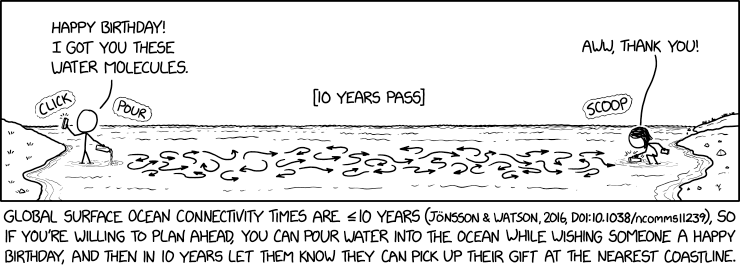
In this comic, Randall seems inspired by the timing of ocean currents, much as he has previously been with air currents, although he may even have already considered some of the technicalities prior to that. As supporting evidence, he provides a DOI reference to a 2016 Jönsson & Watson open-access article in Nature Communications, 'The timescales of global surface-ocean connectivity'.This would be extremely impractical, since in ten years, it's possible that you and the recipient broke connections, or one of you (or both of you) passed away. If these scenarios are not the case, ten years is an awfully long time to wait for a present.
In this specific (fictional) example, the water dumped into the ocean today will take ten years to circulate round to the depicted neighbouring coastline (wherever that is). Which implies significant planning ahead is necessary before posting water to someone. And a lot of presumption about the lack of any other dispersal/dilution, or that some degree of fungibility is acceptable, so long as it is philosophically the same group of molecules involved. Of course, some of the water molecules may take a short-cut by being evaporated then precipitated closer to the delivery site.
The title text mentions that "same-ocean delivery" may only take a few years, as the coast lines are in the same general body of circulating water, and doesn't have to pass around large obstacles (like continents) or through small gaps (straits). But if you wish delivery from Weddell Sea it may take decades. The Weddell sea lies near the Antarctic Peninsula, part of the Southern Ocean whose circulation can be considered largely isolated from the neighbouring bodies of water by the Antarctic Circumpolar Current. In particular, that area contains the Weddell Gyre one of the two ocean gyres in that area.
The title text also mentions inland seas, which can be generalised as bodies of water that are very large in area but either completely surrounded by dry land or connected to an ocean only by a river or a strait. He mentions the Mediterranean Sea which is only connected to the Atlantic Ocean through the narrow Strait of Gibraltar; the intention of the title text is to suggest that water molecules dumped in an ocean would not get to appear in such a sea (except by evaporation and reprecipitation) into its catchment area) and thus they can only ever circulate back to the dumping point (deemed 'undeliverable').
In reality, the Mediterranean Sea is not completely cut off from the main oceans and surface currents actually do reach into and around the Mediterranean. The natural loss from evaporation is not fully compensated for by the inflow of the incident rivers from southern Europe, North Africa and Asia, directly or via other attached bodies of water (e.g. the Black Sea). The movement of water also involves the deeper Levantine Intermediate Waters layer (a subsurface current) which exits via Gibraltar and helps to further draw current inwards at the surface level. As such, except for a limited amount of water which reverses direction within the extreme western end the Mediterranean, it is more true to say that surface currents cannot actually transport water from within the sea outwards into the Atlantic (and beyond). (This explanation ignores flow through the Suez Canal.)
The Caspian Sea is a real inland sea that has no outlet to any oceans and only inlets from rivers, one of a number of endorheic basins that are also lakes, and thus trivially isolated from all other maritime currents.