Earth/Venus Venn Diagram
Actually, the fact that Mars is still orbiting safely over here means that it was technically an *Euler* apocalypse, not a Venn one.
Actually, the fact that Mars is still orbiting safely over here means that it was technically an *Euler* apocalypse, not a Venn one.
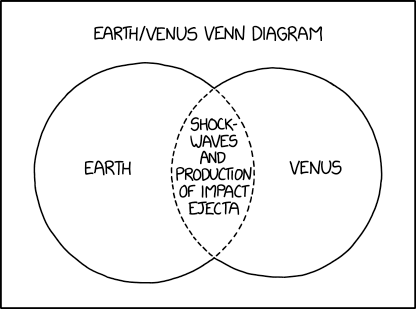
A Venn diagram illustrates the relationships and differences among sets by showing common and distinct elements, using overlapping circles (or other shapes). This comic is both a Venn diagram and a proximity illustration of Earth and Venus colliding, physically 'overlapping' each other.
- As a proximity illustration, it depicts Earth and Venus smashing into each other, resulting in "shockwaves and production of impact ejecta" occurring where they collide. The relative circle sizes are accurate; the circumference of Venus is 5% smaller than Earth's.
- As a Venn diagram, it shows a collision moment in which the commonality between Earth and Venus is "shockwaves and production of impact ejecta" at the spot of intermingled Earth-Venus overlap.
Shockwaves are intense, high-pressure waves caused by the immense force of the impact, that propagate through the materials of both planets faster than the speed of sound.
Impact ejecta are the materials expelled from the impact site, consisting of molten rock, vaporized material, and solid debris, flung out at high velocities due to the energy released by the collision. The production of impact ejecta would indeed occur in the overlapping impact area.
The title text is another xkcd joke about the difference between a Venn diagram and an Euler diagram, which is similar to a Venn diagram except that it's acceptable to have circles (or other shapes) that do not intersect if there are no common elements between those sets. The observation that Mars is still orbiting by itself makes Mars an additional set (out of the frame of the diagram), in addition to - but not intersecting with - Earth and Venus, making this technically an Euler diagram. Therefore if the Earth-Venus collision is a "Venn apocalypse," the inclusion of Mars as a non-intersecting entity makes this technically an "Euler apocalypse."