Eclipse Path Maps
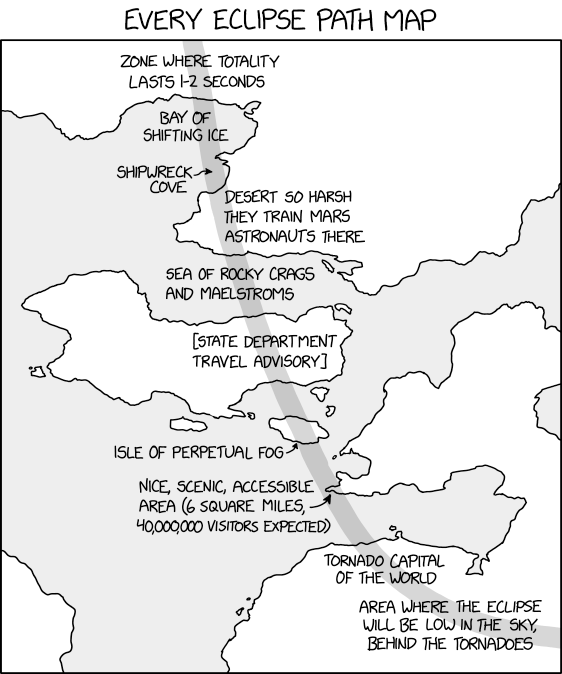
Okay, this eclipse will only be visible from the Arctic in February 2063, when the sun is below the horizon, BUT if we get lucky and a gigantic chasm opens in the Earth in just the right spot...
Okay, this eclipse will only be visible from the Arctic in February 2063, when the sun is below the horizon, BUT if we get lucky and a gigantic chasm opens in the Earth in just the right spot...
A total solar eclipse occurred on April 8, 2024 in North America, nine days before this comic. This comic comments on the fact that most solar eclipses happen on territories not easily reachable by humans, places with weather conditions that make viewing the eclipse less appealing, like cloudy skies (mentioned previously in 2915: Eclipse Clouds and 2917: Types of Eclipse Photo), fog, or tornadoes (also a recurring subject on xkcd), or areas that experience only a short period of totality.
Zone label Geography Suitability for observation Zone where totality lasts 1-2 seconds Land No stated issues for visiting, but rendered all too brief an experience for astronomical reasons. Bay of shifting ice Water
(part frozen)Open water might make this location accessible by boated observers. Solid ice might grant observers ready access by skidoo, ski and/or skid-plane. Shifting ice causes problems for all these modes of access. Shipwreck cove Water/Coast The name implies the likely impediment to any boat access. Desert so harsh they train Mars astronauts there Land
(peninsula)Implied inhospitable, and probably a lack of any normal transport/accommodation infrastructure. Sea of rocky crags and maelstroms Water
(straits)Yet more risk of nautical hazards, including strong rotating currents. Possibly a nod to Scylla and Charybdis from The Odyssey. [State department travel advisory] Island Unknown risk, but probably involves some form of political instability, war, or major health hazard that makes unnecessary visits highly inadvisable. May also be a result of adverse weather effects. Or perhaps all of these at the same time. Isle of perpetual fog Island
(inc. littoral zones?)Meteorologically unfortunate (ground visibility; may not fully obscure the skyward view). Nice, scenic, accessible area (6 square miles, 40,000,000 visitors expected) Land Apparently one plot of land is ideal for eclipse viewing in all respects. Naturally, everyone else wants to be there too.
For scale, forty million visitors is slightly more than the total population of California (alternately, somewhere between those of Canada and Poland). Six square miles is about one tenth the area of Washington DC (similarly around one tenth of Liechtenstein or, if you prefer, less than eight times Monaco).
This would mean up to three people for every square metre, even before accounting for existing population and obstructions, as well as a high probability of travel congestion.Tornado capital of the world Land Meteorologically unfortunate (frequent disruptive wind vortices, and cloud cover likely). Area where the eclipse will be low in the sky, behind the tornadoes Land Astronomically disadvantageous, with added complications from the neighbouring weather system. The title text mentions the solar eclipse of February 2063, and claims it will only be visible from the Arctic, though in fact this annular eclipse will traverse through the Indian Ocean. The eclipse in the comic would supposedly happen when the Sun would be below the horizon, which is a contradiction in terms, since an eclipse is only an eclipse from the standpoint of the viewer — it is equivalent to saying that the eclipse is not visible from that location, but is visible from a location over the horizon, at a point that is at the other end of a direct straight line through the Earth that is directed 'down' towards the unrisen Sun and Moon. It then jokingly suggests that a giant chasm could open up between the location being considered and the location from where it would be visible, allowing people to view it. If this did happen, the chasm itself would likely eclipse the eclipse as a spectacle. In most cases, it would also likely cause severely detrimental effects (for example, magma eruptions, tsunamis, etc.), and would therefore not be considered 'lucky' by most people, despite the small and short-term benefit of being able to view an eclipse from a previously unsuitable location.
Note: The Novaya Zemlya effect can make it possible to observe a solar eclipse when the Sun is below the horizon at the poles during certain weather conditions. Also called a "polar mirage", the effect is when an atmospheric inversion ducts sunlight along the surface of the Earth for distances up to 250 miles (400 km), which would make the Sun appear 5° higher in the sky than it actually is. This appears to be the rare situation where Randall was unaware of an obscure scientific phenomenon that would contribute to a joke.
Possible references to actual eclipses
- Despite the solar eclipse of April 8, 2024 passing through many populated areas of the United States, many weather forecasts a few days before were pessimistic, predicting significant clouds, and even thunderstorms, along a large majority of the eclipse path. Examples of forecast maps are here and here. Only the very northeast bit of the path had consistently good forecasts, leading to news reports of an all-nighter of traffic jams, which the comic may be alluding to.
- The solar eclipse of August 12, 2026 starts in Siberia, almost touches the North Pole, then touches Greenland, (barely) Iceland, and finally sets in Spain around 8:30pm local. In the relevant part of Siberia, the local time will be very close to midnight and the Sun will still be below the horizon for some. (The Sun will rise around midnight, just before/during/after totality depending on location, and then set after 10pm local.) In Spain, the length of totality will be significantly shortened due to the shallow angle at which the Sun (and therefore the Moon's shadow) hits the Earth. Notably, this is the next upcoming total solar eclipse as of this comic's publish date.
- The solar eclipse of August 2, 2027 touches the southern edge of Spain and Gibraltar, then proceeds to go through numerous areas known for their political instability.
- The solar eclipse of November 14, 2031 takes place entirely over the Pacific Ocean.

