Exponential Growth
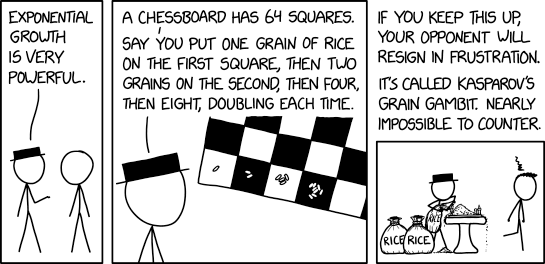
Karpov's construction of a series of increasingly large rice cookers led to a protracted deadlock, but exponential growth won in the end.
Karpov's construction of a series of increasingly large rice cookers led to a protracted deadlock, but exponential growth won in the end.
In this strip Black Hat begins by demonstrating exponential growth, using a variation of the wheat and chessboard problem, a classic demonstration of this mathematical principle. Exponential growth involves an initial quantity being multiplied by any number greater than one again and again. It can cause small numbers to compound into very large numbers faster than might be intuitive. This principle is important in a number of real life applications, ranging from biological growth to inflation to reaction kinetics.
The earliest versions of this story come from India and involve a man (the inventor of chess, in some tellings), being offered a reward by a king, and asking that a single grain of wheat (rice, in some versions) be placed on the first square of a chessboard, two on the second, and each subsequent square having twice as many grains as the one before. In the story, the king generally laughs off such a reward as being trivial, but soon learns that the reward would be impossible to pay. Since a chessboard contains 64 squares, the final square would contain 263 (9,223,372,036,854,775,808) grains. This would be around 600 billion tonnes of wheat (which, even in modern times, would be centuries of global wheat production).
In some versions of the story, the man is executed for embarrassing the king and/or being over-greedy; in others, he's rewarded for his cleverness; in yet others he becomes king himself as a consequence. There are also other versions that subvert the well-known tale by the king not being so naïve as to fall for the 'trick' played by the creator of the problem.
Black Hat initially appears to be using this example, to demonstrate a mathematical principle, but actually turns out to be using it to "win" a chess match by covering the chess board in rice until his opponent quits out of frustration. Naturally, despite his claims that it's "nearly impossible to counter", under the International Chess Federation (FIDE)'s Laws of Chess, this would be illegal on several levels, as deliberately distracting or annoying your opponent is a violation, as is deliberately displacing the chess pieces. Black Hat, being the chaotic classhole that he is, likely simply doesn't care, and counts it as a win when his opponent Hairy stomps off out of annoyance.
Garry Kasparov and Anatoly Karpov are both Russian chess grandmasters and former world champions. The two men famously competed for the world championship in the 1980s. The Kasparov gambit is a famous gambit that Kasparov played multiple times (but not, as Black Hat's is, something that can be played very early in the game). The title text implies that Kasparov actually tried Black Hat's method on Karpov, who attempted to consume all the rice with "increasingly large rice cookers", but eventually couldn't keep up. While this is obviously fictional,[citation needed] it fits with the principle of exponential growth. If exponential growth is unrestricted, it will eventually grow beyond the constraints of anything that could plausibly be built to contain it.
In any case, it appears that in his enthusiasm to enact his scheme, Black Hat has neglected to even set up his own pieces (or they have already been completely buried), never mind wait for the game to commence, so Hairy has nothing to resign from - indeed his king still appears to be standing as he walks away, so he may be only assumed to have resigned/defaulted due to competition rules that cover various circumstances in which one may leave the playing area (but, apparently, nothing too restrictive about bringing in sacks of rice).
Another unusual Kasparov gambit is mentioned in 3082: Chess Position.