Local Group
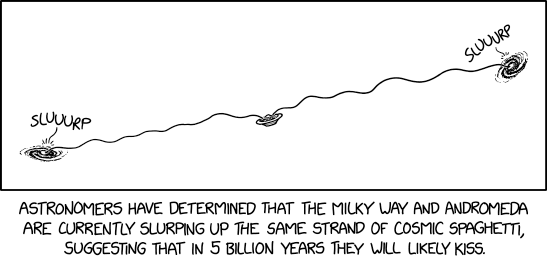
Cosmologists estimate the spaghetti strand to be about 200 septillion calories, though it could be higher depending on the nutritional value of dark matter.
Cosmologists estimate the spaghetti strand to be about 200 septillion calories, though it could be higher depending on the nutritional value of dark matter.
In less than 5 billion years into the future, the Andromeda Galaxy is expected to collide with the Milky Way. This comic suggests this will happen when both galaxies get into a kissing distance after having slurped the same cosmic spaghetti strand. This is a spoof of a famous scene in the movie Lady and the Tramp, where the titular dogs are eating spaghetti at an Italian restaurant. They happen to be eating the same strand from opposite ends, so they end up meeting in the middle and kissing. This scene was mentioned before in 2612: Lightsabers, and has been referenced extensively in other media.
The title text figure of 200 septillion (2×1026) calories for the Milky Way-Andromeda noodle equates to approximately 2500 calories per foot of noodle. This value makes sense only if Randall is referring to the physics/chemistry "small" calorie (= 4.184 joules) rather than the dietary "large" Calorie (= 4184 joules). Dietary Calories, also called kilocalories (kcal), would be the usual meaning in a food-related context like this one, but Randall was trained as a physicist and apparently used the small calorie here. Having 2.5 dietary Calories per foot is roughly correct for a noodle size between thin spaghetti and angel hair. A noodle with similar ingredients and 2,500 dietary calories per foot would be roughly 26 centimeters in diameter, and might more properly be considered a type of pastry (much to Beret Guy's delight).
The nutritional value of dark matter refers to the fact that evidence of 'dark matter' is particularly found in cosmic filaments and the cosmic web, implying that such "cosmic spaghetti" would have an appreciable amount of dark matter "sauce" on it. But, because the exact nature of dark matter is unknown, it is likely even more difficult to identify the calorific content that it might provide. Note that these filaments are much larger structures than the Local Group of galaxies that includes the Milky Way and Andromeda.