Modes of Transportation
My bold criticism might anger the hot air balloon people, which would be a real concern if any of them lived along a very narrow line directly upwind of me.
My bold criticism might anger the hot air balloon people, which would be a real concern if any of them lived along a very narrow line directly upwind of me.
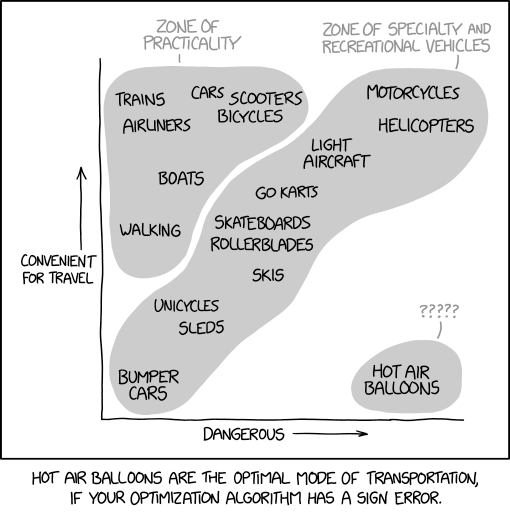
Randall's chart compares different modes of transportation by how convenient and dangerous they are. At the top-left (high in convenience and low in danger) are airliners and trains, as these are both fast-moving vehicles on which many millions of dollars have been spent to make them safer. In the top-right, motorcycles are at the same convenience level, but are rated much more dangerous, since they are easy to lose control of at high speeds, and careless drivers (of cars) can easily hit a motorcycle and cause extreme harm. Things like unicycles (bottom-left) are considered much lower on the convenience scale, being not very fast or easy ways to travel, but relatively safe, while towards the centre, skis are apparently moderately convenient and moderately dangerous, since they are relatively easy to fall on if going fast downhill. Way out on their own in the bottom-right, hot air balloons appear to be unique in being rated least on convenience and highest on danger. Presumably, modes of transportation similar to hot air balloons (like zeppelins and blimps) are left off the chart to increase the gap for comedic effect.
The modes are grouped into several zones by darkened backgrounds -- the easiest or most effective that are also the safest ones (trains, cars, walking, biking, boats, etc.) are in the Zone of Practicality at the upper left. The ones that are mixed, ranging from very useful for travel but dangerous (motorcycles and helicopters) in the upper-right, through moderately dangerous and moderately unpractical (go karts, skateboards, rollerblades, skis, light aircraft) in the middle, to quite safe but totally unpractical for travel (bumper cars, unicycles, sleds) in the lower-left are in the Zone of Specialty or Recreational Vehicles. At the extreme of dangerous and very unpractical (lower-right) is a zone labeled simply ????? containing only one mode: Hot Air Balloons.
Because a hot air balloon is rated so poorly, if an optimization algorithm considers it the optimal mode of transportation, it must be the result of a sign error (e.g. having a minus sign where a plus sign is supposed to be, or vice versa), making the algorithm optimize for the opposite result by mistake. This could be because, unusually, on the y axis of the chart higher is better, whereas on the x axis lower is better. If these were treated the wrong way around, it would result in the air balloon appearing to be the best result. More typically, you might plot convenience vs safety, so that a higher value on either axis would represent a better result. However, both measures are still likely to need to take underlying data (for safety, incident counts, etc.; for convenience, travel time, etc.) and invert them, leading to potential for errors.
In order to compare the relative danger from each mode of transport, one can look at statistics of fatalities and injuries sustained during each activity. Traditionally this can be reported in fatalities/KSI per mile driven or passenger mile (or other unit of distance), to account for the fact that some modes are used much more than others and make valid comparisons. They may also be reported per capita (but this ignores the relative usage of different modes), or per journey (but this doesn't take into account the fact that different modes typically have different journey lengths and times). All of these are somewhat flawed, since they are really measuring the danger to users of that mode of transport, both from their own conveyance, and from other sources such as other road users. Since ballooning is not a very common mode of transport, hot air balloon incidents are correspondingly uncommon, and flights are not routinely monitored or registered, it is difficult to draw strong conclusions from the data for hot air balloons.
The title text makes a joke that if a hot air balloon enthusiast disagrees with the ranking and is angered by it, they may wish to remonstrate or retaliate, but will have a difficult time getting to Randall's house with their preferred mode of transportation, because they are limited to travelling in the direction of the wind. If they chose an alternative form of transport, they would be making his point for him. In reality, hot air balloons have some freedom to choose their direction of travel, since by controlling their altitude they can access different wind directions at different heights. Randall should, therefore, be concerned about hot air balloonists who live within a wedge spanned by the various wind directions accessible on a given day. In principle, if the weather conditions are favorable, this could cover every direction from Randall's house. The phrase "hot air balloon people" is reminiscent of "autogyro people" from the title text of 1972: Autogyros.
Curiously, the comic includes most common forms of transport, and a number of less common ones, but omits examples such as buses (a mass transit solution arguably more convenient than trains). It is not clear if this is an error, or a deliberate choice to maintain the comic's layout and presentation. Another omitted mode of transportation is horseback riding, which would possibly win over hot air balloons in sign-error optimization because in spite of horseback riding's increased convenience relative to hot air balloons, it is also more dangerous, especially if counting horse deaths. However, unlike hot air balloons, horseback riders could get to Randall's house even if the wind is not blowing in the exact right direction, and once they are at Randall's house, they could potentially have their horse kick down Randall's front door or even kick Randall, the latter of which could be fatal, so perhaps Randall intentionally omitted horses from the diagram for his personal safety.
This is the second comic in a row to feature an algorithm.
Transportation Description Convenience Danger Zone Trains Mass transit on rails, typically between urban centers. 89±2%: Convenient and comfortable, provided proper funding/maintenance and filled timetables. Allows relatively cheap travel for many people at once. 11±7%: Exceedingly safe, due to dedicated tracks along a controlled environment. In places with strong safety regulations and well-maintained infrastructure, fatalities are generally limited to individuals wandering onto the off-limit tracks. Practicality Airliners Mass transit by aircraft 81±2%: Extremely fast travel between population centers for larger groups of people. Less comfortable and more expensive than trains. 16±9%: Extremely safe due to strong regulation and relatively little traffic interactions. Most accidents are also minor, resulting in few if any injuries and no fatalities. However, the few catastrophes that do happen often have high death counts. Practicality Cars Motorised road vehicle
Most common method of long distance travel, used by many individuals to reach specific destinations90±2%: Owners of a car can usually go easily to any road-accessible location within a 200 mile/300 km radius. Requires constant focus, but can transport a few passengers or some cargo. Parking, maintenance, and infrastructure requirements are often ignored when judging car convenience. 30±5%: While collisions can be extremely serious, due to the high speeds and large mass of most cars, decades of advancement have resulted in most cars being designed around safety considerations, which protect the passengers from serious injuries in most accidents. While road fatalities remain high in many countries, the per-mile rate rate of injury and death is relatively low, compared to many means of transit in this chart. Practicality Scooters Either:
- Kick scooter - Less convenient than the placing would suggest.
- Low powered motorbike/moped - More dangerous than the placing would suggest.
- Engine-powered scooter - A middle-ground.
89±2%: Kick scooter-style vehicles are probably less convenient than bicycles as they do not provide seating, and are less efficient at converting energy into motion. A low-powered motorbike is about as convenient as a bicycle, requiring refueling in lieu of pedalling, and going much faster. 46±10%: Kick scooters are much slower – and therefore safer – than bicycles. Some motorized scooters can reach speeds comparable to car travel, but they are usually limited to speeds around average cycling speeds. Falling from one might be slightly safer than from a bicycle. Low-powered motorbikes often go much faster than bicycles, and would therefore be much more dangerous. All leave the rider vulnerable to danger from motorised traffic sharing the same space. Practicality Bicycles Human-powered (or mostly so) two-wheeled road vehicle 84±2%: Assuming proper road or trail connections, bicycles are highly flexible for traveling to any location within a ~10 km radius, or further. They are a very efficient use of human power for producing motion. 41±9%: Bicycles mostly move slow enough for falls or collisions to have little impact, though they are vulnerable to motorized traffic where it shares the road. Around 66% of fatal bicycle accidents occur due to collisions with cars, vans, or trucks.[1] Practicality Boats Watercraft of various types 67±2%: Specialized for water traffic, which is a very common form of transportation. Quite comfortable (unless you suffer from seasickness), but usually very slow. 23±6%: Sinking, capsizing, or falling overboard, whether by collision or misuse, can be lethal, especially on the sea. However, collisions are very rare. Practicality Walking Personal bipedal ambulation
53±2%: Can travel between any two connected points regardless of infrastructure, but most people only find it comfortable for a few kilometers. Very slow compared to even bicycles, but the energy intensity is good for exercise. 14±8%: Due to the slow speed of walking, it's extremely rare for the activity to cause serious injuries or death. The primary risk from walking itself is falling, particularly down stairs or from some other height. Walking may expose a person to outside risks (eg: vehicle collisions, weather exposure, wildlife encounters, crime), but the act of walking itself is exceptionally safe. Practicality Motorcycles Two-wheeled motorized vehicles, generally powered by an internal combustion engine. 91±2%: As practical as cars to move between locations, and sometimes quicker, due to the ability to filter in traffic, but generally less comfortable, especially in rough weather. 86±13%: Motorcycles generally move as fast as cars, introducing all of the dangers that come with speed. Having two wheels, rather than four, there's a significantly higher risk of losing control and falling. Being smaller than a car, there's more danger of not being seen in a potential collision. Most importantly, the driver is fully exposed, lacking both the enclosure of a car or truck and all of the safety features that come with it, and has no protection other than any personal gear they're wearing. In consequence, motorcycles have a per-mile fatality rate 25 times higher than cars, leading to many entries in List of deaths by motorcycle crash. Speciality/Recreational Helicopters Rotorcraft in which lift and thrust are supplied by horizontally spinning rotors. 81±2%: Effective to move between any two points as long as there are landing pads of reasonable size. Can be used to hover relatively still in the air. Speed for utility helicopters is comparable to trains. Very loud, and very difficult to learn to fly. 90±13%: As per Harry Reasoner: "An airplane by its nature wants to fly, and if not interfered with too strongly by unusual events or by a deliberately incompetent pilot, it will fly. A helicopter does not want to fly. It is maintained in the air by a variety of forces and controls working in opposition to each other, and if there is any disturbance in this delicate balance the helicopter stops flying; immediately and disastrously. There is no such thing as a gliding helicopter." While the last is a slight exaggeration, it remains much easier for a helicopter to enter an unrecoverable state than an airplane. Speciality/Recreational Light aircraft In the United States, the general category of small aircraft covers a variety of aircraft certified to weigh 19,000 pounds (8618 kg) or less at takeoff. Maximum allowed weight varies by specific category. 74±4%:Convenience greatly depends on style of aircraft, proximity of airfields to intended destination as well as "first and final mile" transportation, etc. In many areas the need for a trained pilot as well as costs and time spent on the ground at an airfield ("taxi time"), plotting and filing of flight plans, and the variability of weather conditions make surface transportation (automobiles, trains, buses) and scheduled heavy commercial aircraft more practical. However, in areas such as the Alaskan interior and north slope, light airplane travel becomes critically important for living and working in remote areas. 65±9%: Speciality/Recreational Go-karts Low profile, unregulated, four-wheel, motorized platforms that are not street legal 63±2%: A lack of proper suspension makes for a bumpy ride, poor clearance would leave them at risk of grounding on more uneven terrain, and the maximum speed is quite low. 51±9%: Crashing is much more likely to cause spinal damage than bicycles, but the relatively low speed would make them much safer than other motorized vehicle options. Speciality/Recreational Skateboards A board on four wheels 55±2%: Much slower and less energy-efficient than bicycles. 45±13%: As with walking, the primary risks are falling (particularly from a height) or being exposed to some outside danger (such as being hit by a vehicle). Because skateboards can move faster than walking (particularly when going downhill), the risks are somewhat greater, but unless the rider is deliberately doing dangerous tricks, serious injuries are relatively rare. Speciality/Recreational Rollerblades Shoes with a single line of wheels at the bottom 49±2%: Much slower and less energy-efficient than bicycles. 45±14%: Almost identical to skateboards, and for the same reasons. The primary danger comes from falling. The potential speed means that falls are more dangerous than for walkers. Speciality/Recreational Skis Narrow strips of material to stand on while sliding across a low-friction surface 40±2%: A fine way to move downhill relatively fast, but maintenance of the slope is required. Also a fairly quick way to travel on the flat when there is snow cover that would make other modes of transport challenging. Less useful in less conducive conditions. 46±4%:Downhill skiers can reach high speeds at which collisions could cause significant injury to the skier's lightly protected body. It can be hard to control your speed at lower skill levels, but as long as low speeds are maintained (as it might when used as a transportation option), skiing is not that dangerous. See also List of skiing deaths. Speciality/Recreational Unicycles One-wheeled human-powered vehicle 32±2%:While it can be a practical form of transport for skilled riders, unicycles are very low on the "convenience" scale. Having only a single wheel makes balance much more difficult, especially over longer distances, and the lack of gearing makes pedalling less efficient and more taxing, particularly as road conditions change. 24±9%: While riders may be more likely to fall off unicycles than bicycles (particularly when new to them), the low speed and minimal height mean that falls are highly unlikely to cause serious injuries. Despite their difficulty, it's almost unheard of for people to die in unicycle accidents, though low usage rates mean that drawing conclusions from injury data is problematic. Speciality/Recreational Sleds A construction that can slide over snow, ice, or sand 26±2%: Useful in limited conditions in which other forms of transport might struggle to cope with. 28±6%: It is hard to properly control your speed downhill, but extremely safe on level terrain or slight slopes. Speciality/Recreational Bumper Cars Small electric karts with rubber bumpers 10±4%: Only really convenient for making very short journeys. Typically require an electronic mesh in the ceiling to move at all. 14±8%: Because these vehicles usually travel only at very slow speeds, are confined to a small and controlled area, and are protected by large, shock-absorbing bumpers, the risk of serious or fatal injury is low, though riders may be at risk from whiplash, bracing injuries, or impact injuries to hands placed outside the car. Many operators will have rules against ramming other cars head-on, to minimise the risk of injuries. Speciality/Recreational Hot Air Balloons A basket tied to a huge bag of heated air 11±4%: Provide limited control and low speeds, and expose the user to the elements at altitude. They were the primary form of air-travel available in the 19th-century, but were overtaken by powered air-travel. 83±10%: A malfunction in the balloon can result in a very rapid descent, from great height. A poorly executed descent could result in a mid-air collision (e.g. with trees, powerlines, etc.) with potential for a nasty fall. The air that provides the lift is heated by a flame, which may be open, and the envelope catching fire would very likely cause an uncontrolled descent with high likelihood of death. Further known dangers are malfunctions of the propane tanks fueling the burner causing an explosion and falling down the edge of the basket due to improper or no tethering. While accidents aren't especially common, this is because hot air balloons are not common forms of transit. The number of injuries per passenger-mile is at least as high as any other form of transit in this chart. ?????