Water Filtration
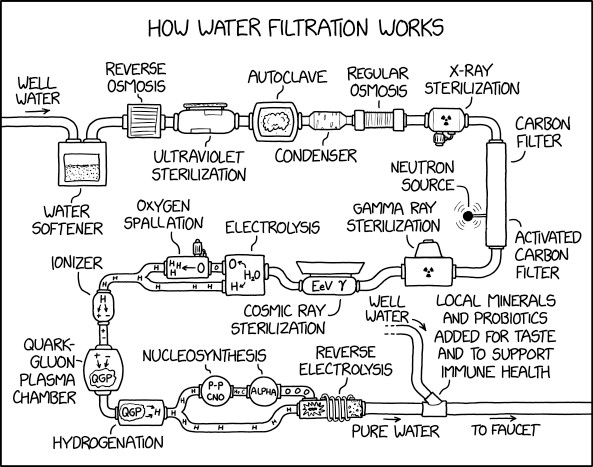
You'd think the most expensive part would be the quark-gluon plasma chamber, but it's actually usually the tube to the top of the atmosphere to carry the cosmic rays down.
You'd think the most expensive part would be the quark-gluon plasma chamber, but it's actually usually the tube to the top of the atmosphere to carry the cosmic rays down.
This comic seems to be a diagram of how well water is purified, a common set of procedures done to make said water safe to drink. However, this well water is "purified" through a series of increasingly unnecessary, expensive, and possibly hazardous steps, ending with producing "pure" water synthesized from hydrogen and oxygen (which have each been synthesized from subatomic particles) - before promptly undoing all of the work by re-adding raw well water and its original minerals and probiotics (which is one way of describing chemical and biological contaminants) "for taste and to support immune health". In real life, groundwater generally only needs treatment for any contaminants (chemical or biological) known to be a problem based on the results of water testing or an incident, but adding the original water back in could be dangerous if the water has not been sampled recently.
Step Real? Used for water treatment? Explanation Water softener Real Yes Water softening is the removal of calcium, magnesium, and certain other metal cations in hard water. The resulting soft water requires less soap for the same cleaning effort, as soap is not wasted bonding with calcium ions. Soft water also extends the lifetime of plumbing and appliances by reducing or eliminating scale build-up in pipes, fittings, reservoirs, and so on. The comic shows the water either being passed through some granulated material (presumably, ion-exchange resins) or into a precipitation chamber for lime (or soda ash) softening. This is one of the few steps in this process that arguably fits the comic title of "Water Filtration." Reverse osmosis Real Yes Reverse osmosis is a common step used in modern water-purification systems. It relies on using osmotic membranes and high pressures to separate water molecules from dissolved solutes and biological substances. Interestingly, it would also act as a softening step, rendering the previous step potentially redundant, depending on the goals for each step. It's also overkill for most wells, as groundwater often needs treatment targeted to only a few contaminants, if any treatment at all. This is one of the few steps in this process that definitely fits the comic title of "Water Filtration." Ultraviolet Sterilization Real Yes Ultraviolet sterilization uses UV lamps at short wavelengths to damage the DNA and thereby kill micro-organisms in the water. In the USA, this is an uncommon method of well water sterilization, as the pathogens most likely to be found in well water (as opposed to surface water) are generally much more responsive to chemical disinfection. Many wells don't even need a disinfection step; whether this well needs disinfection or not, this is hardly the most impractical step in this treatment train. Autoclave Real No Autoclaves are essentially large pressure cookers that sterilize items and liquids through exposing them to a high temperature (~120°C or ~248°F) over tens of minutes in presence of water. By maintaining a high pressure, the boiling point of water goes up. This creates a very hot and humid atmosphere, making efficient heat transfer with all contents and inactivating all biological entities through this heat. They are commonly used in hospital and laboratory settings to sterilize plastics, glassware, equipment and solutions (like bottles of growth medium for bacteria) to be used in a sterile environment. The advantage of this method compared to dry heat (aka putting things in a 150°C-180°C oven until they are sterile) is that most lab plastics survive a passage at 120°C without melting. While difficult to streamline (as this technique is used for batches), it has the advantage over light-based methods that heat gets everywhere, and that instead of just damaging DNA, you also denature many of the proteins and other structures of microorganisms. Some proteins, such as prions, can survive autoclaving intact but, for most purposes, equipment that's been autoclaved can be regarded as sterile. Condenser Real No This step condenses the steam generated by the autoclave back into water. This is a normal part of the process used in "traditional" water purification by distillation. Regular osmosis Real Yes Regular osmosis (also known as "forward osmosis" or "osmosis") is the tendency of a solvent (like water) to flow through a semipermeable membrane towards the side that has a higher concentration of dissolved molecules or ions. It therefore goes from a purer state to a less pure state, the opposite of filtration. However, careful selection of solutes can render this process useful in water filtration. For example, with sugars like glucose or fructose enclosed in a semipermeable membrane, the package can be submerged in a lake or stream, and water will be drawn into the bag producing a drink that is ready to consume, having been filtered by the membrane. Magnetic particles have also been used, as they can be easily separated from the filtered solution with a magnet. X-Ray Sterilization Real No X-ray sterilization is used to sterilize equipment, and may also be used as a cold method (in contrast to techniques like pasteurization) of eliminating germs and killing insects in fresh foodstuffs. X-Rays have also been used to sterilize postal mail. Carbon Filter Fake No The water is passed through some volume of carbon - a riff on activated carbon filters, which are used in water filtration as seen later in the process. The exact allotrope of carbon is not mentioned, so this could possibly be a graphite, carbon nanotubes, or even solid diamond "filter". This is one of the few steps in this process that definitely fits the comic title of "Water Filtration." Neutron Source Real No A neutron source generates high-energy neutrons. High-energy neutrons are highly penetrating and will cause ionization events to occur due to collision with atoms in the water. This can potentially make the water more radioactive due to the generation of radioactive isotopes. Activated Carbon Filter Real Yes Activated carbon is a form of carbon commonly used to filter contaminants from water and air, as it has a large surface area available to adsorb impurities on its surface. While this isn't a strange step to see in a water purification process, Randall makes a pun here with its proximity to the neutron source - the carbon has been 'activated' by the neutron source, and is currently radioactive. Water filtered through this may pick up radioactive isotopes from the filter. This is one of the few steps in this process that definitely fits the comic title of "Water Filtration." Gamma Ray Sterilization Real No Similar to x-ray sterilization, this step uses gamma rays to sterilize the water. Gamma rays can potentially irradiate the water through photodisintegration if their energy is higher than the binding energy of oxygen. Cosmic Ray Sterilization Fake No Similar to the previous step, but this time using high energy cosmic rays to do so. This would be incredibly impractical, as cosmic rays are generally blocked by the atmosphere at high altitudes (as stated in the title text). Furthermore, their extremely high energy (shown to be in the exa-electron volt (EeV, or 1018 eV) range) would cause multiple high-energy particles to be created on impact with the water molecules, irradiating the water significantly. Electrolysis Real No The water is broken down into hydrogen and oxygen gas using an electric current. Assuming the gas outputs of this process are pure hydrogen and oxygen gas, this *would* be an extremely effective sterilization tactic, seeing as no known organism or water pollutant is entirely composed out of hydrogen or oxygen gas. Along with the next few steps, this step may be a misguided attempt to "take the water apart and clean each part individually". The hydrogen is sent to the ionizer, while the oxygen is sent to the oxygen spallation step. Oxygen Spallation Fake No Almost all oxygen in existence was originally created via stellar nucleosynthesis. Now, in this step in the purification, the oxygen is apparently broken down back into hydrogen via a fictional form of spallation. While spallation can form lighter nuclei from heavier ones, there is no known process to convert oxygen back down to hydrogen. It is unclear what happens to the neutrons present in the oxygen nuclei - whether they are removed, used to create hydrogen isotopes or allowed to decay into protons and electrons (the components of yet more hydrogen, when properly reintroduced). The hydrogen formed here is merged with the rest of the hydrogen before being sent to the ionizer. Ionizer Real No The hydrogen output by the previous step is made into a plasma with free electrons and protons (not bound into atoms). Quark-Gluon Plasma Chamber Fake No The plasma output from the previous step is further energized into a quark–gluon plasma, such as the one found just after the Big Bang. This follows the theme of the previous steps, which all serve to break the water down into their elementary components. The incredible energies involved in doing so are unachievable by current technologies (current particle accelerators can form such a plasma for very short periods of time and involve a very small amount of matter), and serve to highlight the impracticality of this setup (as alluded to in the title text). The energies would also result in formation of lepton pairs from energy, which is presumably where the electrons from the previous step ended up. Hydrogenation Kinda No This process converts the quark-gluon plasma output in the previous step into elemental hydrogen, reversing the previous two steps. Presumably, this is done via hadronization and recombination; however, it is unclear how the baryon asymmetry needed to generate matter and not anti-matter is developed. The resulting hydrogen is split into 2 streams leading into the Nucleosynthesis and Reverse Electrolysis steps. In real life, hydrogenation is the process of adding hydrogen to unsaturated hydrocarbons. Nucleosynthesis Fake No Part of the hydrogen produced in the previous step is converted into oxygen via 2 sub-processes. The hydrogen is first converted into helium and carbon through a combination of the proton-proton chain and the CNO cycle as per the labels on the step. The helium and carbon are then converted into oxygen through the alpha process. This step may also involve the triple-alpha process, seeing that the alpha process is typically only applicable to converting carbon into heavier elements owing to the lack of a stable element with eight nucleons. These steps normally occur in the cores of massive stars. It is not known how the oxygen is filtered from the extremely hot plasma of fusion products. Reverse Electrolysis Real No This step is essentially a fuel cell, utilizing an electrochemical reaction to convert hydrogen and oxygen back into water and electricity. Adding Well Water Real Yes A second pipe is linked to the first that simply feeds untreated well water into the pipes, partially undoing the entire process. Even if the well water is only a small portion of the faucet water, its presence has now made the now incredibly pure water impure. This act of putting well water into the faucet after treating it may be a riff on the cultural interest in "spring water" or "pure glacial water" that is said to have additional minerals or beneficial properties but is oftentimes not meaningfully distinct from properly treated tap water. "Local minerals and probiotics added" may be a reference to Coke's "Dasani" brand drinking water, which is purified by reverse osmosis, and then has a package of minerals added to create the flavor (pure water's actual lack of flavor can be perceived as an unpleasantly 'flat' flavor). In addition, drinking only extremely hypotonic liquid intake can induce the body to expel more water than it took in (taking with it some essential minerals that are not being replaced) to try to maintain equilibrium of concentrations. This effect is not directly dangerous, but could exacerbate other bodily deficiencies in the long term and have the issues of greater than necessary liquid throughput than with 'normal' drinking water. The tendency for many 'sports' or 'health' drinks to hype the term 'isotonic' is based upon the idea that an ideal concentration of solutes can be added, in-between the opposing problems of having either too many or too few 'impurities'. The process does not include adding untreated (and probably also untested/unquantified) ground water, which could carry pathogenic organisms and chemicals, and appears to have no mechanism for ensuring what might be an acceptable level of re-blending for the circumstances.
Alternatively, it may be that the level of purity achieved by this setup is so overkill, and the cost per liter processed so high, that it's simply more efficient to treat just enough of the water to dilute the rest of the water to acceptable levels of contaminants. For example, it's common to use a partial bypass to supply water to the shower, since shower water does not need to be potable. Also, some well water systems are clean enough to not need any treatment at all and can be used straight from the well, and some water systems are only slightly high in a single chemical contaminant that can be addressed by blending the water, either with treated water or another source (treated or untreated). Perhaps the treatment process led to enough radioactivity that blending with the original source was required to address radiological contamination (either gross alpha radiation or specific radionuclides).
The title text briefly covers the cost implications of the components. Various 'real' filter elements will have material or energy costs or both, in operation or to replenish their effectiveness, and the high energy input needed to disassociate hadrons into raw quark–gluon plasma (at bulk levels) would seem to require the most in terms of running the equipment. But it is pointed out that to ensure enough cosmic rays reach that particular phase of sterilization, there would have to be a pipe (not shown) leading out to the edge of the atmosphere to optimistically carry down such particles (due to also containing no air, i.e., keeping it out to negate the normal shielding and dissipating effect of the atmosphere on cosmic rays). However, this pipe would not only be a flight hazard, but also to ensure that no air molecules get in, the pipe would have to be similar to a space elevator, which would wreak a lot of havoc on LEO and MEO. Whether a one-off cost or needing regular replacement, the setting up of such a tubular structure (a vertical air-proof pipe perhaps somewhere between 100 and 10000 kilometers high) would be technically challenging and has not ever been actually accomplished. The conditions for a quark–gluon plasma, albeit in limited quantities, at least have been fulfilled at CERN, with its 27 kilometer airless pipe that goes round within a vast circular tunnel.