Phase Change
Even when you try to make nice, smooth ice cubes in a freezer, sometimes one of them will shoot out a random ice spike, which physicists ascribe to kiki conservation.
Even when you try to make nice, smooth ice cubes in a freezer, sometimes one of them will shoot out a random ice spike, which physicists ascribe to kiki conservation.
This comic is a reference to the bouba/kiki effect (the cutest-sounding scientific effect!), which finds that people, regardless of what linguistic and cultural background they come from, have a tendency to associate lower-pitched sounds (such as "bouba") with objects that are big and round and higher-pitched sounds (such as "kiki") with smaller and sharp objects. Some real life examples are the antonyms 'high-low', 'rigid-flowing', and 'tiny-huge'. This is partly due to humans' needs to categorize things.
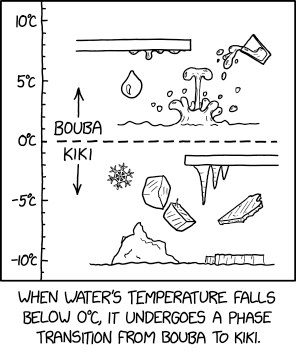
The comic intentionally conflates this with the phase transition that water undergoes around 0 degrees Celsius. Water in its liquid state can be described as soft and round, as can the sound of the word "water" itself. In contrast, ice is hard and crystalline, giving it the potential to form hard edges and sharp points. The word "ice" also contains a sharp hissing sound.
In the above-freezing section of the graph, there are pictures associated with the following (bouba) words: drop, drip, pour, splash. In the below-freezing section of the graph, the pictures are associated with the following (kiki) words: ice, icicle, snowflake, ice cube, iceberg.
The title text refers to ice spikes, which are caused by the uneven freezing of ice in a freezer. The title text expands on the joke by claiming that ice cubes wish to maintain the pointiness of objects characterized as "kiki."