Exclusion Principle
Fermions are weird about each other in a standoffish way. Integer-spin particles are weird about each other in a 'stand uncomfortably close while talking' kind of way.
Fermions are weird about each other in a standoffish way. Integer-spin particles are weird about each other in a 'stand uncomfortably close while talking' kind of way.
This is one of the News comics, delivering big news.
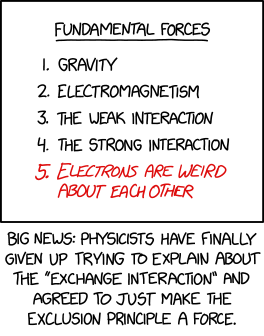
In this comic, Randall lists the four fundamental forces of physics—gravity, electromagnetism, the weak interaction, and the strong interaction—then humorously adds a fifth force called "Electrons are weird about each other." This is a nod to how electrons cannot occupy exactly the same quantum state. The principle that underlies this is the Pauli exclusion principle (also covered in 658: Orbitals, 1862: Particle Properties, and 2351: Standard Model Changes), which says that no two electrons at the same position (within their de Broglie wavelengths) can have the same set of quantum numbers.[1] The idea behind Pauli exclusion isn't really a conventional "force" like gravity or electromagnetism. Instead, it's a result of the fundamental quantum mechanical rules governing fermions, a class of particles that includes electrons. When combined with electromagnetism, it makes electrons repel each other more than mere electric charge would predict on its own.
This phenomenon is sometimes described via the exchange interaction, which can be tricky to explain to non-experts. Randall's joke is that physicists, frustrated with explaining the subtleties of quantum mechanics, have simply decided to create a "fifth force" to cover the weirdness of electrons. In reality, inventing a fifth force to patch up confusing behavior doesn't improve the accuracy of physicists' predictions of how real-world matter and energy behave; they strive for increasingly accurate descriptions of how nature behaves, rather than rewriting the rules in ways that compromise their accuracy in predicting physical systems' behavior in favor of simplicity. An alternate interpretation is that they are studying the actual phenomenon but saying that it counts as a force (much like centrifugal force as discussed in 123: Centrifugal Force).
In the title text, Randall expands the idea from electrons to all fermions, which have half-integer quantum spin and obey the Pauli exclusion principle, and contrasts them with bosons, which have integer spin and can share the same space. He humorously likens fermions to people standing standoffishly far apart, while bosons are like those who stand uncomfortably close while talking—an imaginative analogy for the fundamental differences in their behaviors.