Modern
Scholars are still debating whether the current period is post-postmodern or neo-contemporary.
Scholars are still debating whether the current period is post-postmodern or neo-contemporary.
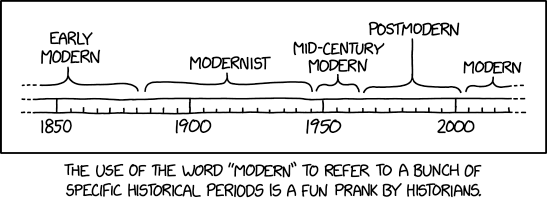
This strip references a perennial naming problem where academic jargon and everyday language meet. Shortly after the industrial revolution (or perhaps the Renaissance) contemporaneous things were significantly different and labeled "modern" by historians, whether it's labor relations, art, economic organization, literature, architecture, etc. The "modern" political movements emphasize optimizing society in different ways. The further development of culture to reject the idea you can optimize society, or that trying to do so is a bad idea, became known as post-modernism.
However, in standard English, modern retains its meaning of "contemporaneous" or "current era", so one can end up discussing a 'modern' era of stuff that comes after the rise of a Post-Modern (from an academic context) era of stuff, which doesn't really sound sensical. One can thus have a movie called "Modern Times", from 90 years ago, which describes a world which is very different from today's modern times.
The problem has arisen because once an era is named it is difficult or impractical to rename it later. The term "Modern" first began being used to describe an era in the early 20th century, especially to refer to art, and then in relation to that "Early Modern" was retrospectively applied to the period before it that were related to it. Once things had moved beyond that then "post-modernity" was a natural way of modifying the name. "Mid-century Modern", was again, a retrospective modification not used at the time. However, things have now moved so far beyond even post modernity, that further words are needed. This is itself a relatively 'modern' problem that possibly arose from the Victorian scholarly desire to allocate names to periods (Classical, Romantic, Renaissance etc.) based upon the perceived societal trends of the individuals, and often across greater periods of time, rather than any single monarch or period of succession.
Prior to that historians would have discussed a time period based on the ruler at the time, and for a given region of influence, as those in charge were believed to be the most important factor, not the masses. Hence 'Ming dynasty' (China, 1368-1644), 'Tudor period' (England and Wales, 1485 and 1603), 'The Commonwealth' (Republican British Isles, 1649-1660), 'Napoleonic' (France and beyond, ~1804-1815), 'Victorian' (British Empire and related lands, 1837-1901) and 'Soviet Era' (USSR, 1922-1991). Though, depending upon the context/comparison being made, all these potentially overlapping terms and more ('19th Century', 'The Interbellum', 'The Depression', 'The Swinging Sixties') may still be considered apt.
The title text claims that there are discussions about whether to dub our current period "post-postmodern" or "neo-contemporary": if historians wish to continue their "prank", they would likely opt for the former.