Sail Physics
Turning in other directions can be accomplished by using a magnetized centerboard and ocean currents, since a current flowing through a magnetic field induces a Laplace force.
Turning in other directions can be accomplished by using a magnetized centerboard and ocean currents, since a current flowing through a magnetic field induces a Laplace force.
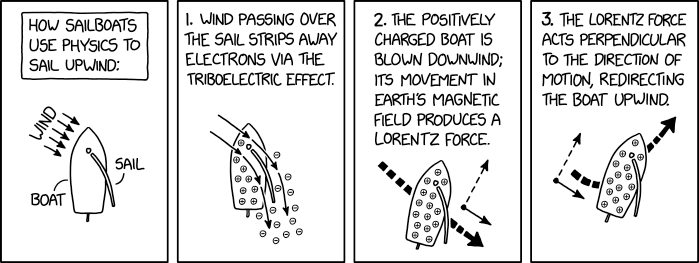
This comic starts off looking like a typical explanation of how sailboats can travel upwind — a topic that continues to spark debate and refinement in physics circles. However, it quickly takes a strange tack into a completely fictional and incorrect theory involving triboelectric charging and the Lorentz force, rather than referencing real mechanisms like airfoil aerodynamics.
This humor works at another level — most interaction of physical things at macro scale (humans and boat sized objects) are electromagnetic in nature. So one unaware of sailing mechanics may start to explain the situation with electromagnetism, and could come to this line of thinking, but it is wrong. If we are to consider this, we find that either no force is appearing in the direction shown, or very little. Sailing into the wind was also the topic of 3013: Kedging Cannon.
- First panel
- The first panel is a fairly accurate diagram used to explain the reasons why a boat can sail into the wind (see below), it just sets up the scenario.
- Second panel
- The second panel portrays the triboelectric effect, which is transfer of static charge through the motion between two 'objects', which in turn depends on effective interaction surface area. It shows charge being accumulated by the wind stripping electrons from the sail of the boat, leaving the sail positively charged. Among other problems, the charge that can be acquired is typically very small.
- Third panel
- The third panel shows the boat being blown sideways by the wind, which a sideways-facing boat hull would highly resist (see below). This motion of a charged body through the Earth's magnetic field, however, results in a Lorentz force. Depending upon the relative directions of motion and the magnetic field, this could generate a perpendicular force in the direction the hull is pointing, as indicated, assuming the entire premise was even as promised.
- Fourth panel
- The final panel demonstrates this force diverting the downwind (and sideways) motion of the boat forward. As well as the various other problems that exist with the whole scenario, this is contrary to promise of allowing the boat to sail upwind, as the originally indicated wind direction and the finally indicated path results, if anything, in movement slightly downwind.
- Title text
- The invokes further technobabble to suggests using a magnetised retractable keel to adjust the nature of the forces. It conflates ocean currents (the global flow of water) and electric currents (the movement of charged particles). Perhaps from the supposed ability to move the magnet through the charge, as opposed to the other way round. It invokes the "Laplace force", which is just a technical variation of the Lorentzian one.
How it actually works
The actual manner of how a boat is able to sail into the wind relies upon the way the wind hits the boat's angled (and curved) sail, producing forces that are divided between those in the direction the boat is heading and perpendicular to it. Sideways forces encounter resistance from the water, leaving a net motion forward, a direction through the water by which a boat hull is designed to more easily pass. This allows a boat to sail at an angle into the wind (though not directly into it), with the right use of sails. The same effect also allows you to travel faster with the wind, at a slight angle away from its direction, than if you just ran exactly in its direction; using the sail square on will limit you to going no faster (and usually significantly slower than) the wind that you are relying upon to push you, whereas an angled sail and boat track can convert the forces into greater speed than even the following wind. An indication of the forces on a sailboat in various directions relative to the wind direction. VT is the true velocity of the wind, VA is the apparent velocity, as seen by the moving boat. Various forces (F) arise from the way the wind hits the sail, which translate into the forward velocity of the boat, VB.
Your speed of sailing perpendicular to the wind tends to be greater than that which you can achieve heading at any angle into the wind, but this is no use if you wish to sail to a destination directly where the wind is coming from. Aiming at an angle into the wind and tacking (briefly use your existing speed to turn directly across the wind), lets you combine sets of aiming off to slightly one side of the wind and doing the same slightly to the other, as required to reach your destination. The expert sailor can choose the point of sail to the wind that makes for the fastest journey time, combining the possible speed and the necessary amount of additional distance. Similarly, turns ('jibes') across the wind allow a more optimal passage to a directly downwind destination than running straight with it.
Supposing that the comic physics had been more capable of doing what it suggests, tacking/gibing could also be important concepts. With two sails made of different materials, one could unfurl that which is able to accumulate a positive charge (by losing electrons) or else another that accumulates a negative charge (by 'borrowing' electrons from the air). In this way, you could account for how the effective direction (and declination) of the magnetic field would be different for any given location, wind direction and intended destination and perhaps eventually make progress in whichever direction the vessel is required to go.
