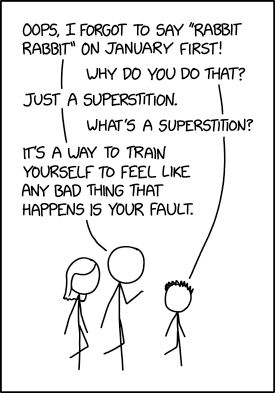
This comic references the superstition, which is known to have existed as far back as 1909, of saying "rabbit rabbit" on the first day of a month in order to have good luck. There are many superstitions about actions that either cause bad luck (e.g. "step on a crack, break your mother's back", walking under a ladder, breaking a mirror, letting a black cat cross your path) or protect against bad luck (e.g. carrying a rabbit's foot, throwing salt over your shoulder after spilling some, knocking on wood after saying something).
When asked to explain what a superstition is, Cueball replies that they're "a way to train yourself to feel like any bad thing that happens is your fault". This suggests that, not only does Cueball not actually believe in the power of superstitions, but sees them as psychologically harmful. After all, believing that bad fortune can be prevented by taking certain actions implies that any bad outcome might have been prevented if you'd taken the right actions. Logically, of course, there's no connection between taking superstitious actions and bad things (or for that matter, good things) that subsequently happen, but superstitions condition us to believe that there is a connection. What's worse, there are so many different superstitions, across so many different cultures, that even keeping track of them, let alone following all of them, is wildly unrealistic, so there's always something you did, or failed to do, on which you can blame any bad outcome. The danger is that a person might personally blame themselves for things that they had no actual control over at all.
The title text refers to the Spider-Man mythology, in which (in most versions) Peter Parker's "Uncle Ben" famously tells him that "with great power comes great responsibility". Peter initially fails to take this lesson to heart, as he receives his superpowers but fails to stop a criminal when he has the chance, and his Uncle Ben dies as a result. This experience then leads to his determination to use his powers to help others, and Uncle Ben's advice becomes something of a mantra for him thereafter.
This text flips that message, claiming that Uncle Ben instead told him that "with responsibility comes great power". This inverts the actual lesson, and suggests that, by simply taking responsibility (even for things over which you have no control), you'll gain power over the outcomes. This is a pretty good summary of what superstitions teach, but can't really be justified rationally. Nonetheless, Cueball appears to believe this lesson, claiming that his uncle died after he failed to say "rabbit rabbit", and implied that the death, therefore, could have been prevented if he'd followed the superstition. In this version of the story, it's not clear whether Peter actually had no opportunity to prevent his uncle's death, and is effectively looking for ways to blame himself, or whether he could have taken real action, but chooses to focus on superstition, rather than ways in which he could have made a real difference.