Double-Pronged Extension Cord
'Oh, and can I borrow 50 sacks of loose flour, a pile of lithium-ion batteries, a bucket of bleach, and a bucket of vinega--' 'NO!!!!!!'
'Oh, and can I borrow 50 sacks of loose flour, a pile of lithium-ion batteries, a bucket of bleach, and a bucket of vinega--' 'NO!!!!!!'
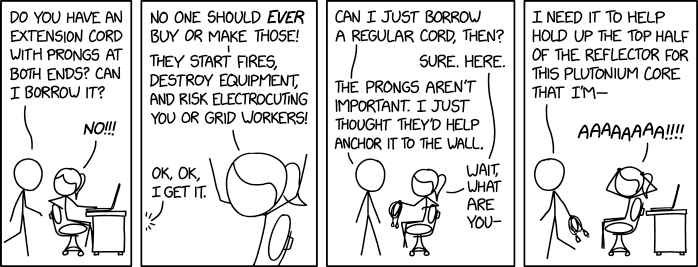
This comic begins with Cueball approaching Ponytail at her desk, asking to borrow an extension cord with prongs at both ends. Ponytail is horrified by the idea because this design of extension cord, often nicknamed as a suicide cable, is lethally dangerous (though it does have some occasional practical uses). It is, at the very least, likely to cause a short circuit and quite possibly a fire when misused, if not pose a more direct electrocution threat to people.
Ponytail seems to relax when she persuades Cueball to use a regular extension cord instead, but he then elaborates that, rather than wanting the cord to carry electricity, he actually intends to use it as some kind of support prop. He thinks the plug prongs at each end are suitable for fixing the cable between two nearby wall-sockets, anchoring the cable as a makeshift tether to support something even more dangerous: a neutron reflector above a plutonium core. Based on his description, his setup appears to be a recreation of Louis Slotin's infamous "demon core" or "tickling the dragon's tail" experiment, with the extension cord replacing Slotin's flat-head screwdriver, an experiment that proved fatal for Slotin. Understandably, this horrifies Ponytail even more.
This is the third comic to reference the "demon core" experiment, after 1242: Scary Names and 2593: Deviled Eggs.
The title text innocently mentions other severe hazards (though arguably none as serious as the radiation hazard).
- Loose flour is a well known fire hazard and the key to a flour-air explosion; 50 bags of it, plus some way to get it into the air, could blow up a sizable building.
- Lithium batteries are well-known fire hazards when overcharged, which is why airport security restricts them from checked luggage. There have been numerous fires caused by the lithium batteries in "hoverboards", leading to them often being banned in cities and airports, and by retailers who might otherwise sell them. A pile of them might be overkill, but if charged in parallel (series probably wouldn't work as well), could cause a noticeable explosion or fire once one of them hit its limit.
- While vinegar and bleach aren't a particular fire hazard by themselves, when combined they do release chlorine gas, which is lethal.
Any acid will tend to liberate chlorine from bleach, though vinegar is a relatively dilute solution of a weak acid (acetic acid). Other acidic household cleaning products, such as drain cleaners, would be much more dangerous to combine with bleach, but generally come with explicit warnings about avoiding this. In contrast, a bucket of vinegar (while an unusual request, in this particular case) could present the same kind of threat, albeit at a lower level, without being commonly associated with that danger. As such, the theme of the title text appears to be "innocuous-appearing supplies which are actually quite hazardous". Ponytail, being both a more knowledgeable person and intimately familiar with Cueball's error prone nature, easily imagines enough of the various unfortunate circumstances that could arise, possibly in combination.