Early Arthropods
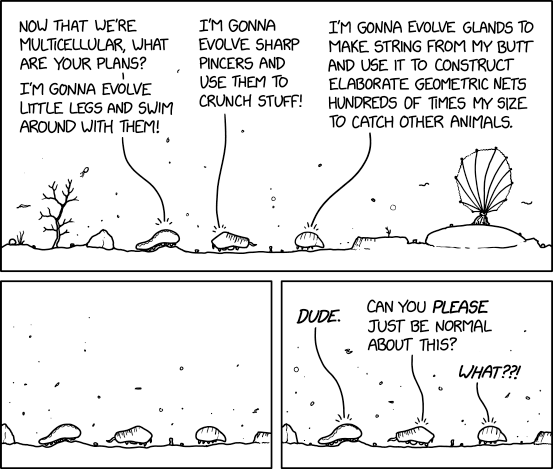
'Ugh, I'm never going to be like spiders. My descendants will all just be normal arthropods who mind their own busines and don't do anything weird.' --The ancestor of a bunch of eusocial insects
'Ugh, I'm never going to be like spiders. My descendants will all just be normal arthropods who mind their own busines and don't do anything weird.' --The ancestor of a bunch of eusocial insects
This comic points out that something we generally take for granted — spiders spinning webs — can seem both amazing as well as weird and disgusting in its details. Whereas the kind of adaptation referred to by the first arthropod (seen in shrimp, krill, isopods, etc.) and by the second (scorpions, crabs, many insects) may seem like obvious things for evolution to arrive at, it's less clear how something would evolve to construct webs.
This strip treats evolution like a conscious process to underscore how strange it would be if a species simply decided to pursue some of these unusual adaptations. Evolution in real life works by natural selection, where small and random adaptations improve the odds of survival and reproduction, and those changes build up into huge changes over the course of long enough time spans. This means that no one decided that a spider's web-weaving ability (for example) was worth pursuing, it happened gradually over millions of years. An intelligent species can accelerate this gradual process of natural selection through artificial selection by choosing characteristics and using selective breeding and culling to favor those. Only humans are known to plan out such breeding (mostly in domesticated species), and even then it is an imperfect process that can be very hit-and-miss. Most biology is the result of evolution without any evident plan.
Spiders are a recurring theme on xkcd.
Crabs are a recurring theme in biology (and conversations with Randall).
The eusocial insects mentioned in the title text, most prominently bees, ants and termites, are other types of arthropods with high levels of social organization. As such, they are notable for not "mind[ing] their own busines [sic]", as their ancestor arthropod apparently expects. Eusocial insects operate in groups, and the individuals often don't operate on their own at all, to the point where the whole colony often acts as a unit, with little regard for the individual. The comment that their descendants "[won't] do anything weird" may be a joke about eusociality being pretty weird to a solitary organism, or may refer to the extreme forms of behavior eusocial insects sometimes pursue. (While there are a number of species of social spider, there aren't any that meet the strict definition of eusociality.)