Carbon Dating
This dating is corroborated by the presence of stone tools at the site, rather than earlier and less effective helium ones.
This dating is corroborated by the presence of stone tools at the site, rather than earlier and less effective helium ones.
Carbon dating is a method for determining the age of an object containing organic material by using the properties of radiocarbon, a radioactive isotope of carbon. This method is commonly used by archaeologists and is invaluable in terms of estimating the point in time a piece of organic matter (such as a fossil) died. It uses the fact that carbon in Earth's biosphere maintains a known ratio between the isotopes 12C, 13C (irrelevant for carbon dating) and 14C. Its intake by living organisms (by photosynthesis, in the case of plants, or by consumption in the case of non-plants, accounting for known fractionation differences) is also relatively stable, until the organism dies and stops taking in carbon compounds. From that point on, its relative concentration in the dead organism can only decrease through radioactive decay. By measuring the relative amount of 14C left in the organism's remains, archaeologists can determine how long ago that organism last actively replenished its carbon, and thus how long ago it died.
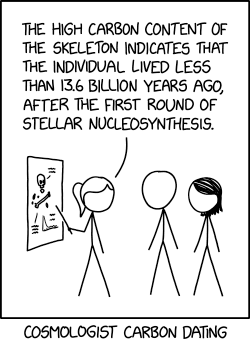
Here, however, Ponytail, in the role of a cosmologist, takes a rather different perspective on using carbon for dating. She is interested only in the mere presence of carbon, which tells her that the skeleton being studied was formed after the first carbon in the universe was created in the first round of stars fusing elements, 13.6 billion years ago. This is not useful information for differentiating artifacts originating on Earth, which is itself less than 5 billion years old, since it would apply to all of them.
The title text looks like the kind of statement that would provide corroborative dating evidence for an archaeological site. The type and composition of tools can help to place a site, relative to others, on a developmental timeline. Here, however, they claim that the presence of stone tools dates the site as later than a non-existent age of helium tools. Tools made out of stone, usually dating from the Stone Age, are often solid and durable, making them great choices for heavy duty tasks, and well-preserved in the archaeological record. Helium is a gas and is difficult to shape into a solid mass for use as a tool.[citation needed] It would also be near impossible to identify such tools if they had existed, since they would tend to disperse easily. Helium was produced in great quantities after the Big Bang, accounting for about ~25% of the mass of atoms produced by the early universe, so would have been available before stone was, but there were no people around at the time to fashion tools from it.
14C is generated in the atmosphere by interactions between nitrogen and cosmic rays, and it is radioactive with a half-life of approximately 5,730 years. It decays over time even as it is replenished, leaving its relative concentration in the environment a matter of the balance between its creation (by cosmic rays, which vary slightly over time, but in a way that can be enumerated) and decay (a constant proportion). Carbon dating is a useful method only so long as the remaining concentration of 14C can be measured accurately, which extends to approximately 9 or 10 half-lives (50,000 to 60,000 years) until the continued halving of the remaining isotope becomes statistically or physically difficult to accurately determine, as well as for lengths of time that are significantly less than this isotope's half-life. Other forms of radiometric dating, based on other elements and isotopes, are used for different lengths of time, as well as situations where such carbon-chemistry is not a reliable component of a sample, or may further validate the result in situations where their respective useful scenarios overlap. Even the ratios between abundances of stable isotopes can vary, providing historical information about things such as temperatures and atmospheric mixing, via isotope geochemistry, as well as in a wider form of radiometric dating for which the presence of stable decay products in a sample can be used to show the original concentrations of subsequently decayed atoms for even better cross-comparison of how much samples such as this will have aged.
The themes of the comic are similar to 2723, which imagines a periodic table published just after the Big Bang, when most elements did not yet exist.